


February 17, 2026
In her MIT lab at The Picower Institute for Learning and Memory, Assistant Professor Linlin Fan seeks to discern the rules and processes by which the brain encodes and stores memories during learning. To do that, she has helped to pioneer “all-optical physiology,” a set of technologies that allows neuroscientists to use light to precisely manipulate the activity of neurons in live animals and read out the effects that has on the neurons they connect with in circuits. With a new fellowship from the Alfred P. Sloan Foundation, she plans to advance the technique to enable investigation of larger volumes of cells deeper in the brain.
Neuroscientists theorize that the brain encodes and stores memories by making changes to connections, or “synapses” among neurons to form new circuits. Directly investigating and testing the process in action to understand the rules that govern it has proven tricky—some older methods are too imprecise, while others are too slow or insensitive.
In recent years, however, Fan and others have demonstrated that by combining multiple technologies, they can genetically target specific neurons in live animals to take control of their electrical activity (“optogenetics”), and engineer other neurons that those cells connect with to optically report even very subtle, quick changes in their resulting electrical responses (“genetically engineered voltage indicators”). Key to these advances has been cleverly designing microscope systems that can direct multiple light paths into a deep brain structure called the hippocampus, a major center for learning and memory, and also detect the multiple optical signals coming out, all without interference.
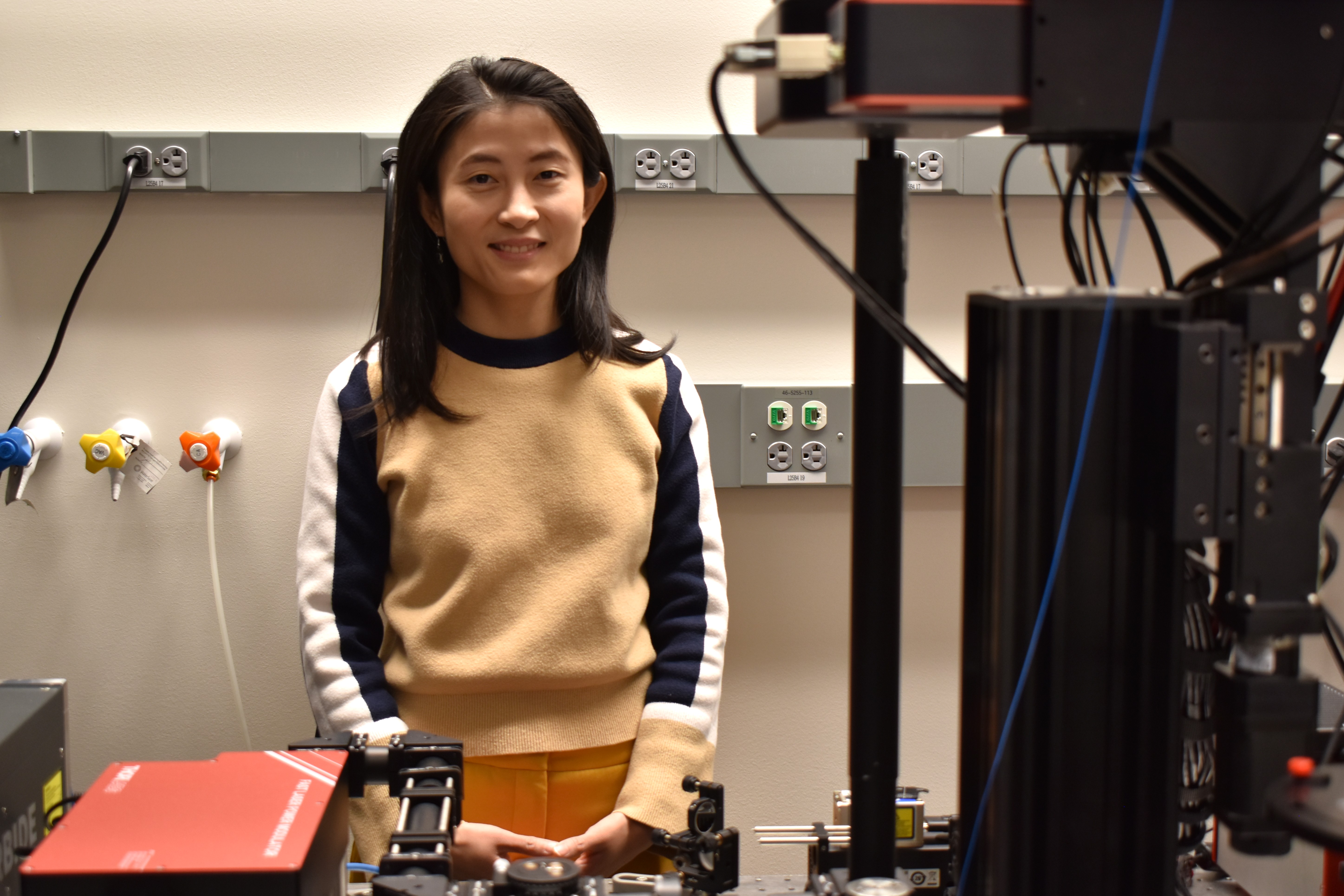
Still, all-optical techniques have only been able to address a few neurons at a time. Now with the $75,000, two-year support of the Sloan Fellowship, Fan said she plans to upgrade all-optical physiology to be able to engage a larger volume within the hippocampus, thereby broadening and deepening the technology’s reach. The work centers on devising a way to integrate “two-photon” microscopy, which enables light to penetrate deeper into tissue.
“Having this more advanced technique will allow us to see more and to see deeper inside this structure,” said Fan, the Samuel A. Goldblith Career Development Professor of Applied Biology in MIT’s Brain and Cognitive Sciences Department and one of eight MIT professors to earn a Sloan Fellowship this year.
“The Sloan Research Fellows are among the most promising early-career researchers in the U.S. and Canada, already driving meaningful progress in their respective disciplines,” said Stacie Bloom, president and CEO of the Sloan Foundation.
In all, the foundation awarded fellowships to 126 researchers from among more than 1,000 nominees. Fan said she is honored to have been chosen.
“I’m very grateful to the foundation for their support of our work,” Fan said. “It’s really a great privilege to be selected as a fellow among other great scientists. Having foundational support for science is more important than ever.”


