

November 16, 2026
At the Clinical Trials on Alzheimer’s Disease conference in Boston Nov. 16, MIT spin-off company Cognito Therapeutics announced the results of its pivotal clinical trial of a non-invasive, device-based approach to Alzheimer’s disease (AD) treatment first discovered in The Picower Institute in 2014. The “HOPE” trial included 663 people in two “prespecified” subgroups of volunteers: those with diagnoses of mild Alzheimer’s; and those with moderate Alzheimer’s. The 395-member mild group benefitted significantly, showing a slowed decline on three standard clinical measures of daily function and cognition relative to untreated controls. Among 169 “protocol-adherent” mild patients who used their devices at least 70 percent of the intended time, the benefits were more extensive.
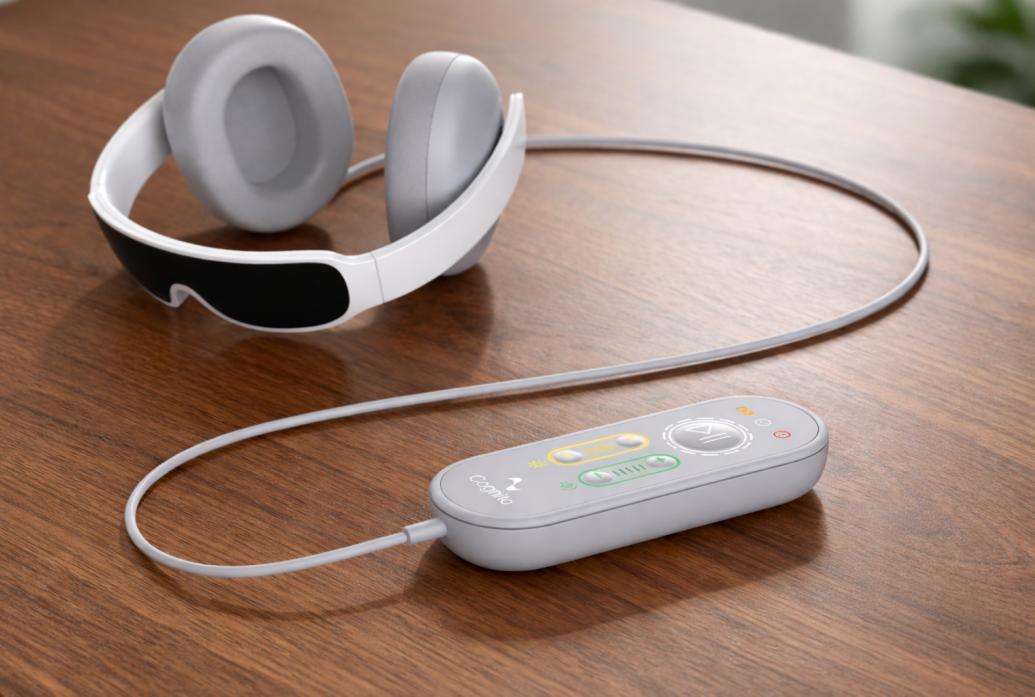
The 268-member moderate group did not show clinical benefit and mild patients did not show statistically significant benefit on some measures. All told, the overall study did not meet its primary endpoint. But based on the significant benefits seen in the mild population, Cognito executives said they would pursue FDA approval for use of their “Spectris” 40Hz light and sound stimulation goggles device (pictured above).
After the 12-month study of 40Hz light and sound stimulation, the mild AD group in the nationwide, randomized, controlled, double-blinded trial showed statistically significant benefits on three tests: ADCS-ADL (56% slowed decline), ADCS-iADL (53% slowed decline) and CDR-SB (47% slowed decline), the company said. The protocol-adherent mild population achieved stronger benefits on those tests (ADCS-ADL: 82%, ADCS-iADL: 82%, CDR-SB: 64%) and reached statistical significance as well on iADMARS (73%). In addition, the company reported that volunteers tolerated the devices well, with no observed unanticipated adverse device effects.
“There is strong evidence in these results that people with mild AD can benefit significantly from 40Hz light and sound stimulation, especially when they keep up fully with treatment,” said Picower Professor Li-Huei Tsai, who has led the collaboration that pioneered MIT’s 40Hz research and co-founded Cognito Therapeutics with colleague and collaborator Ed Boyden, Y. Eva Tan Professor at MIT. “This positive finding, following on years of fundamental discoveries in our labs, is very encouraging, and parallels what we’ve seen in mouse models. It is really a dream come true to see that our basic research has translated into a potential treatment that can help people and their families. I’d like to thank all the volunteers who participated in this study.”
Video: Picower Professor Li-Huei Tsai recounts more than a decade leading 40Hz sensory stimulation research in The Picower Institute and MIT's Aging Brain Initiative
Cambridge-based Cognito’s CEO, Christian Howell, said in a statement announcing the HOPE results that the company would seek FDA approval for patients with mild AD.
“HOPE was designed around a simple but important question: Can we help people living with Alzheimer's disease preserve more of what matters most in their everyday lives?” he said. “Based on our feasibility data, we felt a responsibility to study Spectris in as broad a population as possible. We had hoped to see an effect across that overall population, and we did not. Importantly, what we saw in participants in the mild subgroup brings real hope to patients and families who urgently need alternative treatments. Our priority now is to work with the FDA toward authorization of Spectris AD and bring this potential new therapeutic approach to the people and families who need it.”
For more detailed information about Cognito’s HOPE trial results please see their announcement
Based on fundamental MIT research
Tsai’s first foray into driving 40Hz brain rhythms arose purely out of curiosity when her lab collaborated with that of colleague Christopher Moore in 2009 to test whether optogenetics could stimulate the rhythm in the cortex of mice.
In 2014 her lab began applying the idea to Alzheimer’s, first with optogenetics and then with 40Hz flickering light. In 2016, her team including Boyden and MIT Institute Professor Emery N. Brown published the first discovery that exposing mice to 40Hz LED light flicker for an hour a day for a week could reduce levels of the Alzheimer’s-associated protein amyloid in the brain. The gamma-frequency rhythm’s power and synchrony are compromised in people with AD and in mouse models, but Tsai’s studies have shown that 40Hz sensory stimulation can bolster them. Ever since, a mission of Tsai’s team in MIT’s Aging Brain Initiative, has been to investigate the cellular and molecular changes induced by such Gamma Entrainment Using Sensory Stimuli, or “GENUS.”
In 14 peer-reviewed papers so far, Tsai’s team has reported that GENUS using sound, longer-term light, light and sound combined, or tactile vibration can each produce meaningful benefits in mouse models. They have shown that GENUS also produces benefits in mouse models of Down syndrome, ‘chemo brain’ and myelin deficiency. Their studies have found that the stimulation reduces neuron and synapse loss, reduces levels of amyloid and tau pathology, preserves myelin and the oligodendrocyte cells that produce it, and sustains memory and cognition.
The studies have broken new scientific ground by documenting that sensory stimulation of brain wave power and synchrony can change the molecular activity and gene expression of brain cells including neurons, microglia, oligodendrocytes, and astrocytes. In 2024, for example, Tsai’s lab led a study in mice indicating that 40Hz audiovisual stimulation drove changes in neurons, astrocytes and the brain’s vasculature to promote clearance of soluble amyloid by increasing glymphatic clearance of the protein via cerebrospinal fluid. An Independent studies have since provided corroborating evidence for glymphatic clearance, including ones in mice and one in non-human primates.
Over the course of the last decade many independent labs have studied 40Hz non-invasive stimulation in Alzheimer’s and other disorders in animal models and, at small scales, with human volunteers (using either sensory stimulation, or electromagnetic methods called tACS or TMS), providing an ever-expanding evidence base for the approach.
Earlier human trials
In 2022, Tsai’s team published results of an early stage, pilot study including 15 volunteers with mild AD. At three months, the group that received 40Hz audiovisual stimulation exhibited significant preservation of hippocampus volume, reduced enlargement of brain ventricles, improved indicators of sleep, and improved performance on a visual memory test. The small study also documented increases in brain network connectivity with no serious adverse effects.
Cognito has published several papers of results from its earlier phase “OVERTURE” trial, which involved 76 volunteers. That safety and feasibility trial also reported no serious adverse results and provided evidence that the treatment preserved myelination and slowed the decline of cognition and daily functioning.
Tsai said she plans to continue her fundamental research on 40Hz sensory stimulation as well as human studies including one to assess whether the approach can prevent Alzheimer’s symptoms in people at risk for the disease.
“This exciting advance of a non-invasive, device-based therapy for Alzheimer’s disease and MCI is rooted in years of fundamental research at MIT,” Tsai said. “We are eager to continue that work exploring how sensory stimulation of gamma rhythms affects and protects the brain.”
A coalition of private philanthropists and foundations has sustained the research, which has also received funding from the National Institutes of Health. Tsai said she thanks the supporters who have enabled these studies in her lab..


