


November 13, 2026
The wondrous nervous systems of bats, birds, worms, snails, hydra, planaria, axolotls, flies, ants, fish and jellyfish each had a turn on the stage in MIT’s Building 46 when 10 experts convened at The Picower Institute for Learning and Memory’s fall symposium “Comparative Neuroscience: Lessons from Biodiversity” Nov. 4.
In all, the presentations provided a rich set of examples of what neuroscientists can discover by exploring the innumerable innovations, evolution has built atop a common molecular and cellular foundation. Hydras and humans alike have neurons that join together in networks, but only one of those two species will survive being cut into pieces and only one can write an essay on Baudelaire.
“There’s this incredible unity at the molecular scale: The blueprints for all these different species are encoded in the same DNA and all of these animals are then built using basically the same biochemistry,” said symposium organizer Brady Weissbourd, Thomas D. and Virginia W. Cabot Assistant Professor in The Picower Institute and the Departments of Biology and Brain and Cognitive Sciences. “But as neuroscientists as we start to think about these higher levels of complexity, I think there is still a lot to be understood about to what extent does that unity persist? Are there general principles at these levels of circuits and network and dynamics and behavior and when they are observed, why is that?
“What are the options for nervous system design,” Weissbourd asked. “What can we learn from species differences?”
Above: Assistant Professor Brady Weissbourd delivers his talk on how jellyfish regenerate their nervous systems in Singleton Auditorium of MIT's Building 46.
Regeneration & organization
Several speakers focused on the dramatic example of regeneration, noting that while the ability is common, the extent varies tremendously (e.g, humans can heal a skin cut, while axolotls can grow back multiple severed limbs at once), as do the neural mechanisms that enable it.
In his own work with Clytia hemispherica jellyfish, Weissbourd has discovered that the animals can regenerate pretty much their entire nervous system within the span of a week. He’s been tracking how the remarkable regeneration occurs and comparing it to the systems that enable normal neural network maintenance. Among his key questions are what guides replacement neurons to their proper places, how they connect into networks and how they then generate the activity necessary to play their proper roles in behaviors such as swimming and feeding. Understanding how nervous systems can integrate new neurons, he noted, can lend valuable insights for improving human regenerative medicine.
Harvard biologist Jessica Whited brought axolotls into the conversation. In her studies she has observed that when an axolotl loses a limb there isn’t just a local neural response to promote the regeneration process, but a systemwide one, too. She’s uncovering the biochemical and sympathetic nervous system mechanisms at play and offered a hypothesis about why the response isn’t just local. In the perilous natural lives of salamanders, there’s no guarantee that an attack would remove just one limb. A systemic response to a bad injury makes sense if injuries could become widespread. Sure enough, in field studies she has encountered unlucky salamanders regenerating multiple limbs at once.
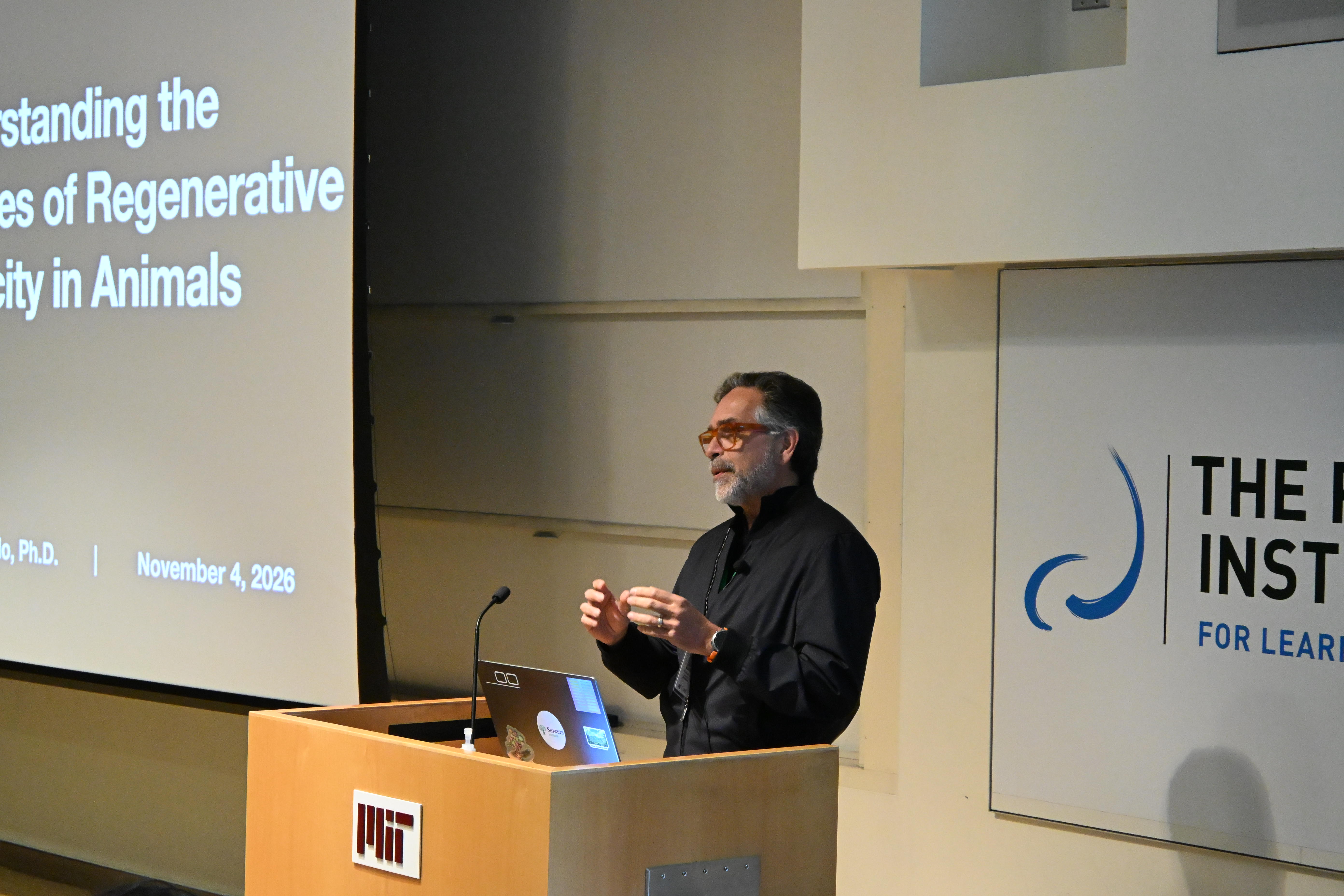
Alejandro Sánchez Alvarado of the Stowers Institute for Medical Research brought two more examples of regeneration to the audience: apple snails and planaria. The snails can rebuild an entire eye if it goes missing, complete with a new optic nerve, but it can’t replace its brain. Planaria, however, can rebuild their brains if needed. The key to regeneration in at least some animals, he says, seems to be that under circumstances such as severe injury, cells that seem like they’ve settled into a permanent identity can transiently shift into states that promote regeneration.
In his talk about nematode worms, Oliver Hobert of Columbia University added to the discussion of cell state flexibility. In particular he highlighted how across hundreds of millions of years of evolutionary divergence, two nematode genuses still share the same nervous system construction. But what differed from species to species, he found, was cell subtype, based on differences in gene regulation and expression. For instance, he highlighted a specific set of sensory neurons that the species shared in common from a structural standpoint, but that expressed proteins differently, accounting for meaningful functional differences from the same architecture.
Adrienne Fairhall of the University of Washington showcased several examples of how different species construct networks of neurons, including for regeneration, even without external prompting. Hydras, for instance, can spontaneously reconstitute their nervous systems even when they’ve been scattered into dissociated cells, forging new synapses among neurons. Such “unsupervised” regenerations even occur in more complex animals such as Zebra finches. In an experiment she and colleagues purposely hindered the circuits by which they produce their songs. But within days, the circuits restructured themselves to restore the songs. Notably the birds didn’t need to actually sing to do this. So while many neuroscientists focus on how neural network formation and synapse formation depends on neural system activity, such as responding to sensory inputs, Fairhall showed how nature has evolved mechanisms that don’t require activity.
Cognition and social behavior
Many other scientists at the symposium delved into discussing the neural underpinnings of animal cognition and behavior,
For instance, Michael Yartsev of UC Berkeley, described how he’s solved a mystery of animal navigation by combining studies in his lab with observations in the field. It’s well known that animals with a hippocampus region of the brain have “grid” cells to keep track of locations. The grid is 2D, which suits animals such as rodents that crawl around. Yartsev wondered what it’s like in bats, which can fly around in 3D, but he found that bats don’t have a 3D grid. He learned why when he went to study them in their natural environment. He found that the vast majority of the time, they fly in 2D planes (embedded within the 3D space of the air) so 2D grids are sufficient for them to map their paths.
Herwig Baier offered two examples of fish behavior and “thinking.” He showed the circuitry that enables Zebrafish to tightly couple their visual and motor systems so that they can lock in on paramecium prey and execute the turns needed to chase it down. In another fish species, Lamprologus ocellatus, he described how they build nests out of shells they find on the sandy bottoms of East African lakes. The fish innately know what kind of shell they’ll find suitable and what they want their next to look like, but also have the capacity to learn (by practicing) what it will take to build a specific shell they find into that ideal next. He also described the specific neural circuitry that drives those behaviors.
Ozzies are solitary, he said, but many animals are social. Three speakers shared widely varied models of social behavior and its neural correlates. Vanessa Ruta of Rockefeller University brought the audience into the wild world of fruit fly mating rituals, for instance. When males see females they begin a pursuit and create a mating song by beating their wings. When females hear the song they respond to mate, but when competing males hear it, they respond by counteracting their rivals (such as flicking their wings to push them away from the female). Ruta described the neural circuitry in each sex that accounts for the behaviors and compared variations in mating behaviors across several fly species.
Rockefeller colleague Daniel Kronauer, meanwhile, focused on the advanced social lives of ants and, in particular, how much it depends on their elaborate olfactory systems. Ant scouts sniff out prey and lay pheromone trails for their friends to follow to it, but they also depend on senses of smell, which he has been dissecting and mapping, to distinguish their littermate friends from members of their rival colonies. Understanding the elaborate nervous systems underlying their olfaction is therefore, the key to understanding their social behavior.
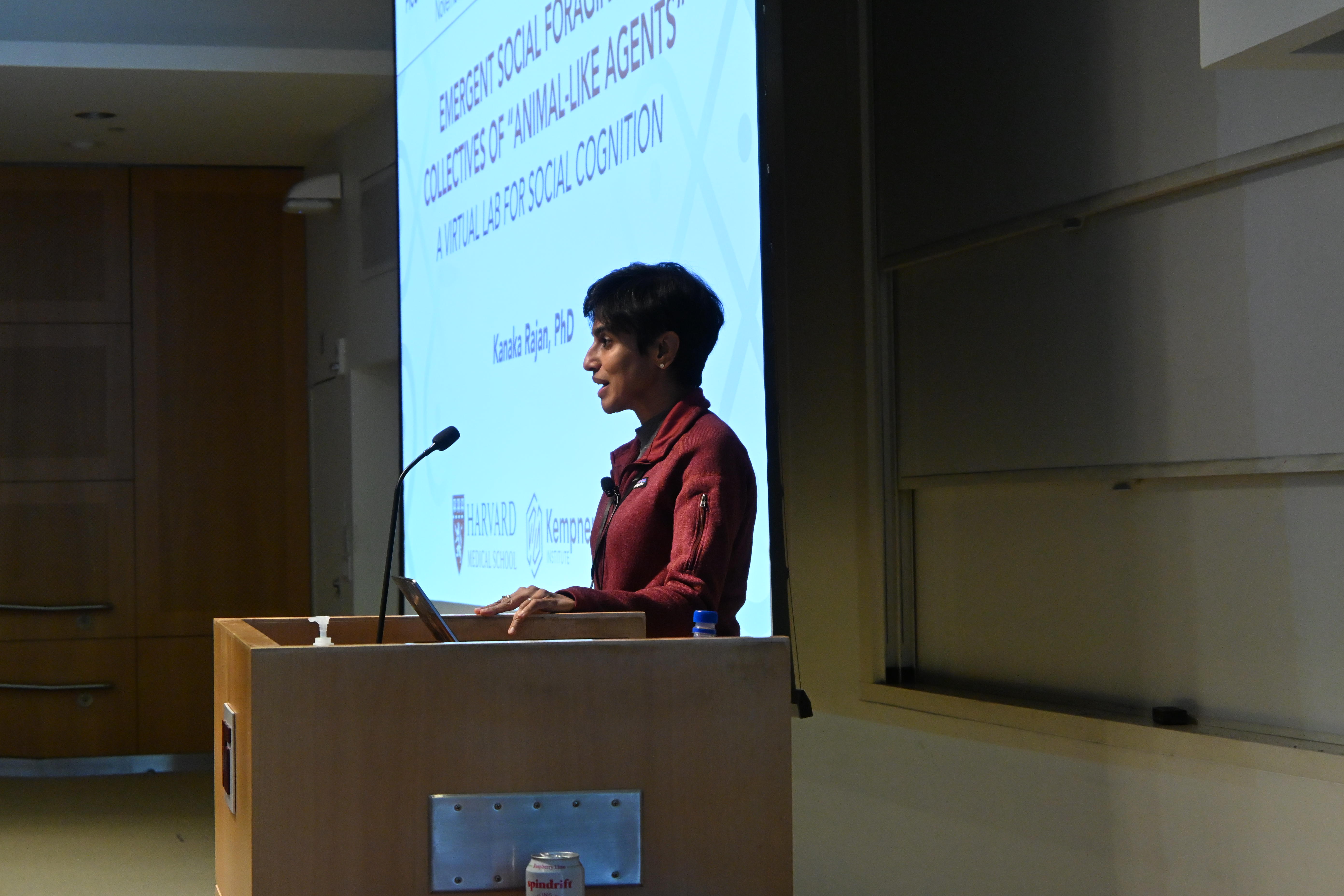
Elephant-nosed fish use a very different means of social communication: electric pulses. In her talk, Kanaka Rajan of Harvard discussed how she uses computational modeling to understand social interactions among small “collectives” of the fish. Among the behaviors she’s simulated are cooperation in looking for food, social dominance and more complex interactions, modeling each fish as an agent with its own neural network that can produce and sense virtual electrical pulses and seek food for a reward. A lot of realistic behaviors have simply emerged from the collective actions of the fish without having to be explicitly programmed.
In her concluding remarks, Picower Professor and institute Director Myriam Heiman celebrated the diversity of the organisms and studies by noting that broadly surveying the animal kingdom gives neuroscientists a richer set of ideas of how nervous systems can enable the behaviors necessary for existence in the world.
“A comparative approach can reveal not only what nervous systems do in common but also the different routes that evolution has taken to meet very similar demands,” Heiman said. “Comparative neuroscience enlarges the space of possible answers.”


