


April 26, 2026
Alzheimer’s disease is best addressed as early as possible, ideally before symptoms become apparent. To enable early, accurate risk prediction both for individuals and whole populations, a team of AI researchers, physicians, and scientists centered at MIT has released FINGERS-7B, the first AI foundation model built to make Alzheimer's preventable. The team will present the model at ICLR, one of the largest AI conferences, April 27th in Rio de Janeiro
FINGERS-7B integrates lifestyle, clinical, genomic, and proteomic data from tens of thousands of at-risk individuals to discover "multi-omic" biomarkers for preclinical Alzheimer's. On WW-FINGERS network datasets, it delivers 4× more accurate preclinical diagnosis and 130% better responder stratification than prior art.
The model is open source and is deployed in the AD Workbench, the secure cloud environment operated by the Alzheimer's Disease Data Initiative (ADDI) and used by Alzheimer's researchers worldwide.
FINGERPRINT pairs FINGERS-7B with AI agents that run automated multi-omic analyses. The model was trained on data from tens of thousands of people at risk for Alzheimer's, and learns jointly from lifestyle, clinical, biomarker, genomic, and proteomic signals. The novel concept is the multi-omic biomarker. Instead of reading one omics domain at a time, FINGERS-7B reads them together. That is what makes earlier and more accurate detection possible, compared to single data source systems.
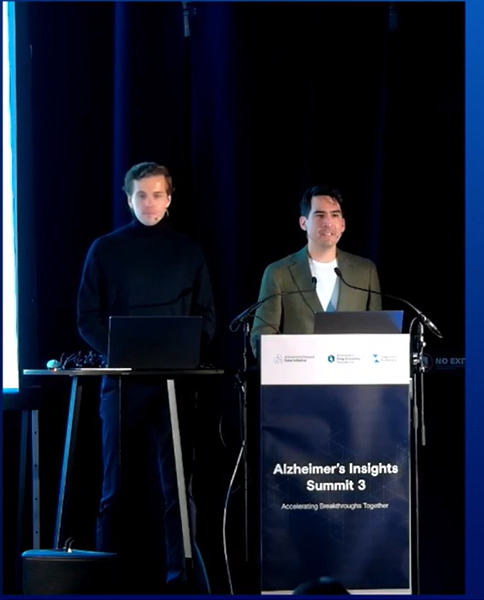
"Each of us carries a biological fingerprint, basically a unique combination of signals that reveal disease risk and, if properly understood, could enable prevention and treatment of Alzheimer's disease," said Adrian Noriega, MIT-Novo Nordisk AI Fellow and FINGERPRINT co-lead with Arvid Gollwitzer, Broad Institute research scholar, who led the design and training of FINGERS-7B. "FINGERPRINT is a discovery acceleration engine composed of specialized agents and new foundation models that interpret these biological signals to help us find novel biomarkers, prevention interventions, and therapeutics."
FINGERS-7B has identified a set of novel diagnostic biomarkers for preclinical Alzheimer's, the stage that can precede memory symptoms by a decade or more. The model also produces personalized analyses: given an individual's data, it predicts risk, the likely time course of cognitive decline, and the effect of candidate interventions, from dietary change to therapeutics.
"Even as Alzheimer's research labs like ours have gained the capability to generate huge volumes of data, including genetic, epigenetic and proteomic profiles from human tissue samples, we've faced the challenge of truly integrating all of it to gain a comprehensive view of individuals' risk, prognosis and likely treatment response," said Li-Huei Tsai, Picower Professor and director of the Picower Institute for Learning and Memory at MIT. "Early on it became clear that FINGERPRINT would be a remarkable example of how AI could help."
The project builds on Professor Miia Kivipelto's landmark FINGER study in cognitively unimpaired but at-risk older adults, and on the global WW-FINGERS network it inspired. Those studies now span 40 countries and 30,000 participants, focused on risk factors and lifestyle interventions that can prevent disease onset. FINGERPRINT integrates their clinical and lifestyle data with biomarker, genomic, and proteomic datasets from collaborating labs and industry partners.
MIT's Aging Brain Initiative, which Tsai directs, seeded the effort last June with a $100,000 grant to Noriega and Giovanni Traverso, Professor of Mechanical Engineering. Within ten months the team trained FINGERS-7B, shipped the AD Workbench deployment, and opened the model for external use.
Model weights, training code, and evaluation pipelines are all public. Any research group can apply FINGERS-7B to its own cohort and contribute results back. Deployment in the AD Workbench puts the model directly in front of researchers and clinicians already working on Alzheimer's prevention, without asking them to move sensitive patient data or stand up new infrastructure.
Other members of FINGERPRINT include Tsai, Traverso, and Kivipelto. Industry partners include Alamar Biosciences and Novo Nordisk. Additional institutional partners include the Broad Institute, Yale University, Imperial College London, and the Brigham and Women's Hospital.
Even before its public release, FINGERPRINT became poised to make a global impact on Alzheimer's research. In February, the Davos Alzheimer's Collaborative and the FINGERS Brain Health Institute announced a partnership to employ FINGERPRINT to advance research on Alzheimer's prevention. A key goal of that partnership is to do so in a way that encompasses people all over the world, capturing the true diversity of the globe's population. The team was also a finalist selected from among about 200 teams to compete last month in Copenhagen for AI Insights Data Prize, sponsored by the ADDI and Gates Ventures.
"Someone was going to build the foundation model stack for Alzheimer's prevention," Gollwitzer said . "It should be open, and it should be now."


