


October 15, 2026
One of the main ways that the APOE4 gene variant, the biggest genetic risk factor for late onset Alzheimer’s disease, undermines brain circuit function is by disrupting the process of insulating neurons with a fatty sheath that optimizes their electrical transmission. A new study led by neuroscientists at The Picower Institute for Learning and Memory at MIT provides several lines of evidence to implicate a specific molecular pathway in that disruption and uses that insight to demonstrate an intervention for preventing it in lab experiments.
The study published today in Cell Stem Cell shows that APOE4 leads to a suppression of “Wnt” signaling in the oligodendrocyte cells that provide neurons with a fatty insulation, called myelin. When Wnt signaling is deficient, they showed, the cells accumulate droplets of lipids rather than deploying fats to properly myelinate the neurons’ axon branches. When the researchers restored Wnt signaling in APOE4-carrying oligodendrocytes, myelination rebounded, both in human cell cultures and in mice modeling Alzheimer’s.
The research team led by Picower Professor Li-Huei Tsai and study lead author Leyla Akay, a former graduate student in Tsai’s lab, discovered Wnt’s key role via multiple methods including a screen in which they used CRISPR gene editing to systematically knock out each protein-coding gene in the genome, one by one, in cultures of human APOE4-carrying oligodendrocytes. The screen showed that when genes promoting Wnt activity in oligodendrocytes were lacking, lipid droplets accumulated, and that when genes suppressing Wnt were lacking, lipid droplets were, too.
“This proof of principle of doing CRISPR screens for genetic modifiers of APOE4-associated lipid accumulation in a central nervous system cell type is very exciting,” said Tsai, who also direct’s MIT’s Aging Brain Initiative. “I think this type of screen not only provides new insights into cellular pathways contributing to lipid metabolism defects, but really also has the potential to provide new targets for drug development.”
For want of Wnt
In 2022, Tsai’s Lab led by Akay, Djuna Von Maydell, Jose Davila-Velderrain and Joel Blanchard (also a co-author of the new study), showed that APOE4 caused lipid droplet accumulation in oligodendrocytes and upset myelination. But, Akay said, that droplet accumulation could happen for many reasons. The new study sought to dig deeper into the underlying molecular mechanisms.
“This CRISPR screen allowed us an unbiased way to test every single possibility,” Akay said. “What kind of lipid enzymes are involved in this process? And what are upstream pathways that could be targeted?”
In parallel with the CRISPR screen, the team also analyzed the chromatin accessibility of the DNA in human oligodendrocyte cell cultures and in postmortem human brain samples, in each case comparing APOE4-carrying samples to ones carrying the neutral APOE3 variant. This analysis of ATAC-seq data allowed them to assess which genes were most accessible for expression vs. which ones were locked down from transcription. The chromatin analysis showed that genes promoting Wnt signaling were less accessible in APOE4 carriers.
“There was a striking overlap between ATAC-seq and CRISPR screen results,” Tsai said. “Both pointed to a dysregulation of the Wnt signaling pathway.”
Toward a therapy
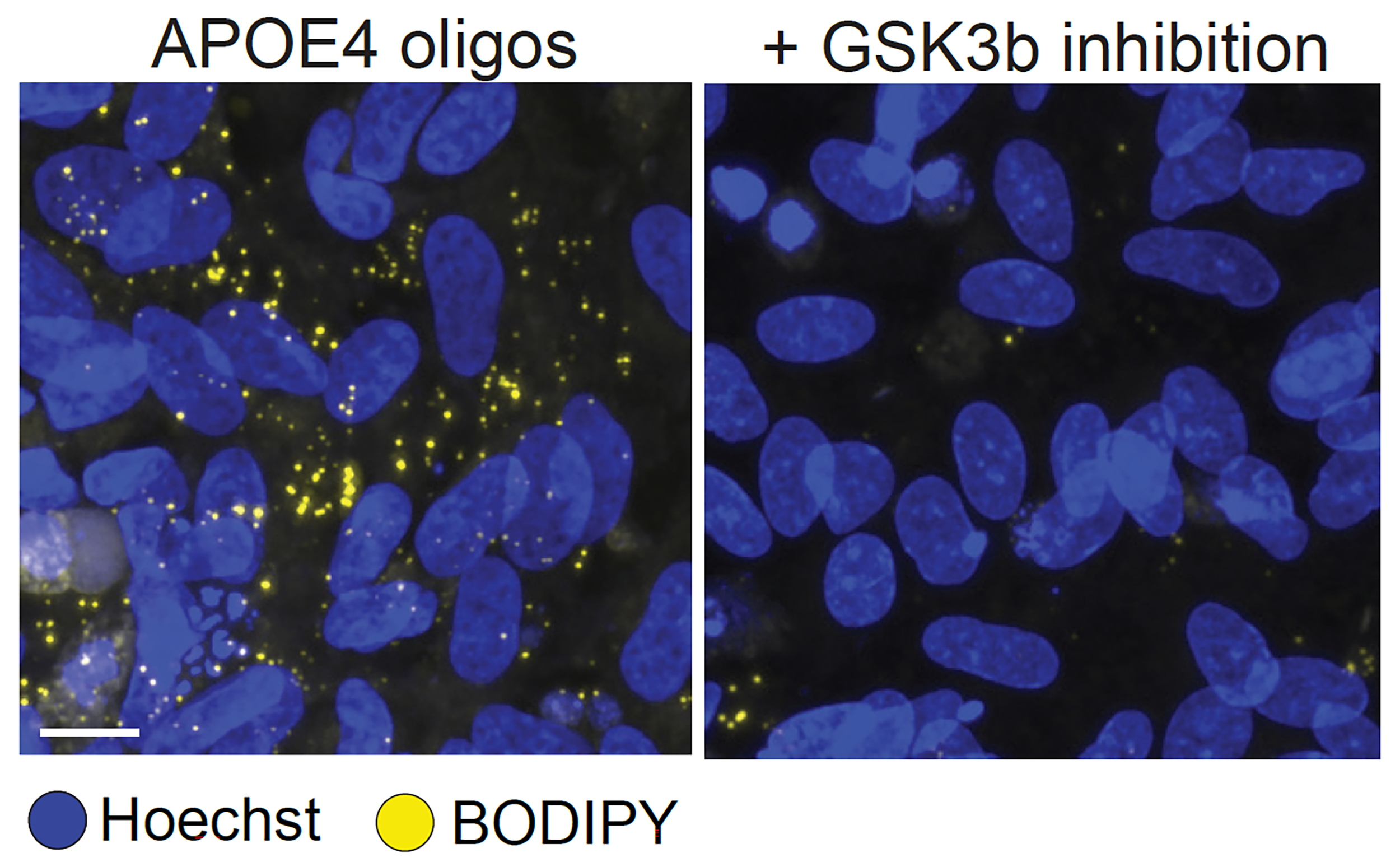
Further analysis, including direct observations in cells at the lab bench, revealed how Wnt signaling became depressed in cultured APOE4 oligodendrocytes. Two proteins, beta-catenin and GSK3b, each compete to regulate Wnt—beta-catenin promotes it and GSK3b suppresses it. The team found that in APOE4 oligodendrocytes compared to APOE3 ones, there was reduced beta-catenin expression and excessive GSK3b expression.
The team then tested interventions that manipulate GSK3b activity. In human APOE3 oligodendrocyte cultures, they showed that increasing GSK3b with a chemical called Dif3 increased lipid droplets. In APOE4 oligodendrocytes, they showed that inhibiting GSK3b with a chemical called CHIR99021 reduced droplets. In more complex “organoid” cultures combining APOE4 oligodendrocytes with neurons, they found that inhibiting GSK3b increased myelination and promoted the growth of neural axons.
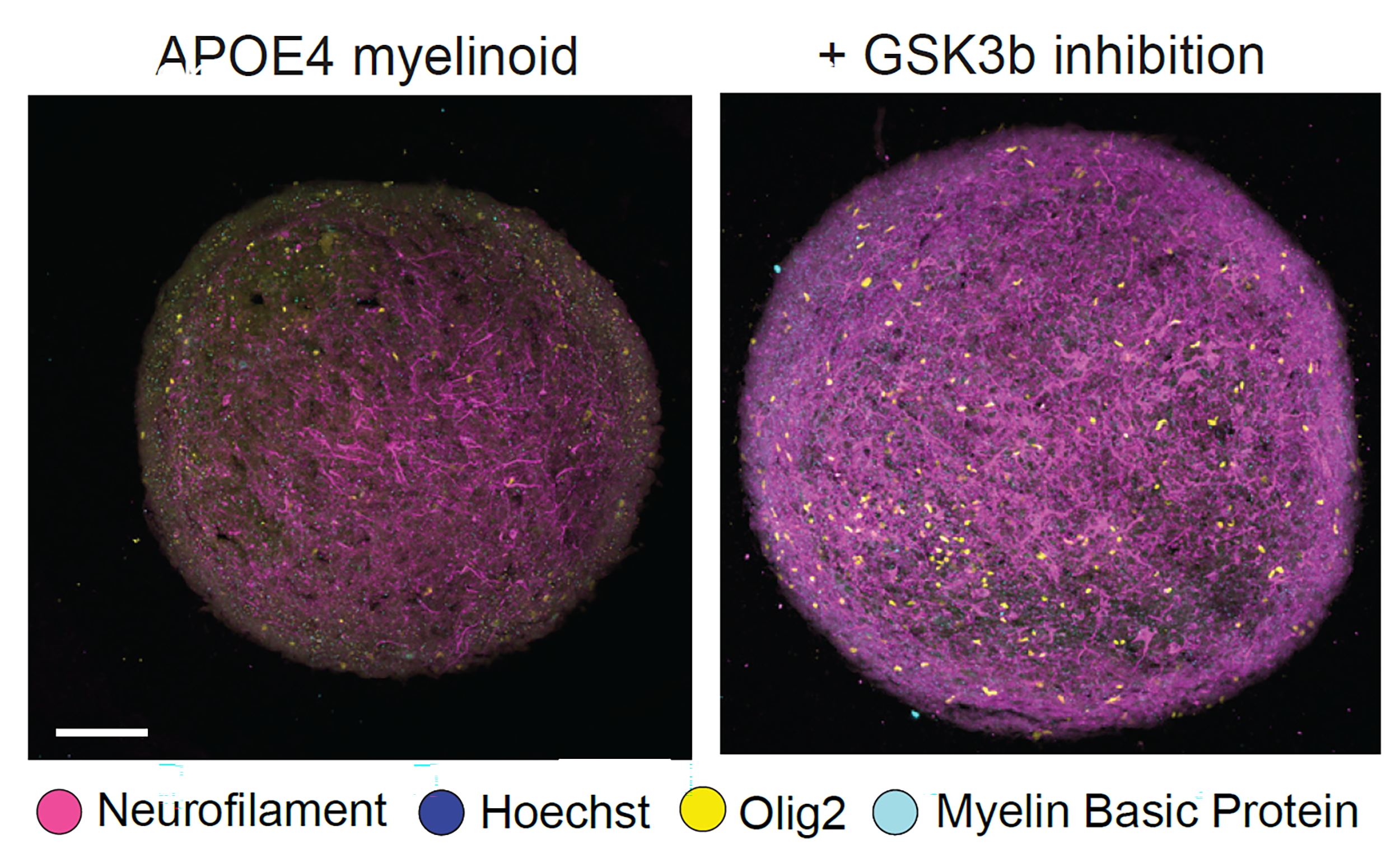
The tests suggested that GSK3b inhibition could be a proof-of-concept therapeutic strategy for restoring Wnt signaling and myelination. As a final test, they treated mice carrying APOE4 and genetically modeling Alzheimer’s tau pathology with doses of CHIR99021. The treated mice exhibited a reduction in lipid droplets in the hippocampus of the brain, a key memory-making region. Moreover, they also showed increased myelination there, compared to untreated controls.
In addition to highlighting suppression of Wnt signaling, the CRISPR screen and chromatin analysis provided key clues about the molecular mechanisms by which loss of Wnt alters how oligodendrocytes metabolize lipids. Akay and Tsai said they are eager to follow up on those clues. They are also interested in investigating GSK3b’s linkage to tau phosphorylation, a major feature of Alzheimer’s pathology.
In addition to Tsai, Akay and Blanchard, the paper’s other authors are Anna Bright, Daiyun Dong, Ethan Smith, Robert Hurt, Carles Boix, Kate Louderback, Janine Medrano, Dingcheng Sun, Haonan Lin, Oisín King, Gwyneth Welch, Hiba Nawaid, Emre Agbas, Alan Jiang, Adele Bubnys, and Ji-Xin Cheng.
The National Institutes of Health, the Robert and Renee E. Belfer Family Foundation, the Manthripragada McManama Alzheimer's Fund, the CAMA Seed Fund, the J. Crayton Pruitt Foundation, Joseph P. DiSabato and Nancy Sakamoto and the Freedom Together Foundation provided funding for the study.
Raw data from the study is available on the Open Science Framework. Akay and Tsai have applied for a patent on the CRISPR screen results.


