

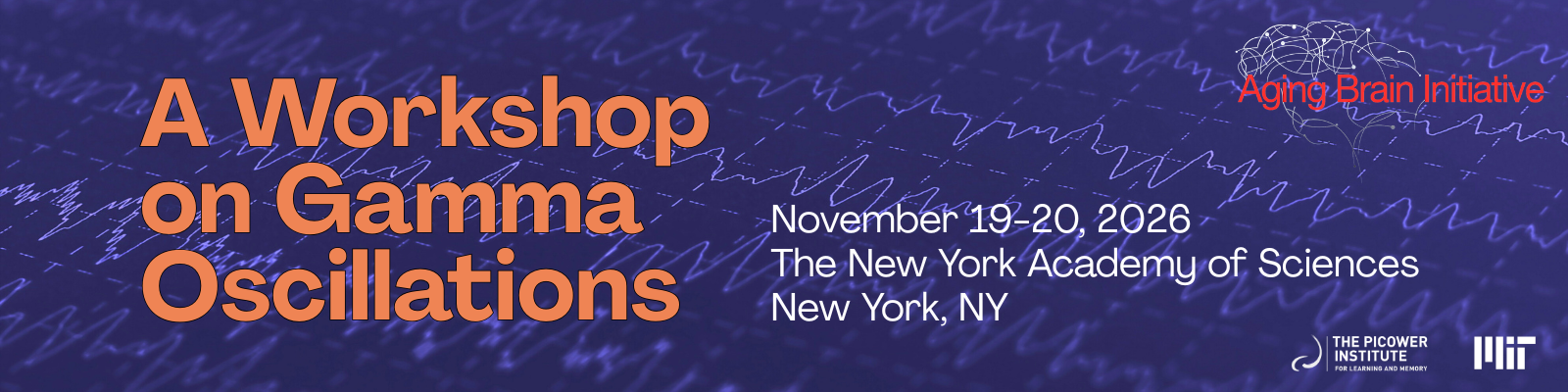
Date: Thursday, November 19th - Friday, November 20th
Location: New York Academy of Sciences, 115 Broadway, 8th Floor, New York, NY 10006
Hotel: New York Marriott Downtown, 85 West Street at, Albany St, New York, NY 10006
Thursday, November 19
12:00-1:00 PM Arrival and Registration; Light Lunch Served
1:00-1:10 PM Opening Remarks, Simon Hanslmayr, University of Glasgow
Session 1: Brain Oscillations in Cognition/Memory/Perception
- Chair: Jorge Palop
1:10-1:40 PM Simon Hanslmayr, University of Glasgow, Probing Plasticity in Human Memory with Multisensory Flicker Stimulation
1:40-2:10 PM Antonio Fernandez-Ruiz, Cornell University, Hippocampal Oscillations for Memory and Prediction
2:10-2:30 PM Danying Wang, University College London, Altering Stimulus Timing via Fast Rhythmic Sensory Stimulation Induces STDP-Like Recall Performance in Human Episodic Memory
2:30-3:00 PM Vikaas Sohal, University of California, San Francisco, Prefrontal Gamma Synchrony and Cognitive Flexibility
3:00-3:20 PM Break with Refreshments
3:20-3:50 PM Christopher Moore, Brown University, Gaining on Gamma: Beyond Electrodes
3:50-4:20 PM Annabelle Singer, Georgia Tech, Tuning the Brain: Engineering Neural Rhythms to Reshape Circuit Function
4:20-4:50 PM James Dowsett, University of Stirling, Decoding Real-World Visual Scenes from Alpha and Gamma Band Flicker Evoked Oscillations in Human EEG
4:50-5:30 PM Discussion Panel, 40'
5:30-5:50 PM Break with Refreshments
Keynote Address
- Chair: Li-Huei Tsai
5:50-6:30 PM Wolf Singer, Max Planck Institute for Brain Research, Oscillations, Waves and Spikes: A Unifying Theory of Cortical Computations
Friday, November 20
8:00-8:30 AM Arrival and Light Breakfast Served
Session 2: Gamma Oscillations in Disease & Therapies
- Chair: Laura Colgin
8:30-9:00 AM Yadong Huang, University of California, San Francisco, Sharp-Wave Ripple–Associated Slow Gamma Links APOE Isoforms to Cognitive Vulnerability and Resilience in Alzheimer’s Disease
9:00-9:30 AM Mark Bear, Massachusetts Institute of Technology, Gamma Oscillations Induce Metaplasticity that Influences how Experience Modifies the Brain
9:30-10:00 AM Tjaša Mlinarič, KU Leuven, Visual Gamma Stimulation: From Intracranial Recordings to Alzheimer’s Disease Continuum
10:00-10:30 AM Diane Chan, Alnylam Pharmaceuticals, Neural Substrates Generating a Gamma Frequency Response to 40Hz
GENUS Light and Sound Stimulation
10:30-10:50 AM Break with Refreshments
10:50-11:20 AM Emiliano Santarnecchi, Harvard University, Tuning Gamma with Transcranial Electrical Stimulation: From Cognitive Enhancement to Dementia
11:20-11:50 AM Christian Howell, Cognito Therapeutics, Cognito’s HOPE Trial Results: What a Study of At-Home Light and Sound Stimulation Found in Alzheimer’s Disease
11:50 AM-12:30 PM Discussion Panel, 40’
12:30-1:30 PM Lunch Served
Session 3: Mechanisms and Circuits of Gamma Oscillations
- Chair: Christopher Moore
1:30-2:00 PM Laura Colgin, The University of Texas at Austin, Theta and Gamma Coordination of Hippocampal Place Cells
2:00-2:30 PM Jorge Palop, University of California, San Francisco, Parvalbumin Cell State Dynamics During Gamma Oscillations in Health and Alzheimer’s Disease
2:30-3:00 PM Jiang-Fan Chen, Wenzhou Medical University
3:00-3:20 PM Break with Refreshments
3:20-3:30 PM Harsha Bhardwaj, Centre for Brain Research – IISc, Bangalore, Circuit Mechanisms of Gamma Stimulation-Induced REM Sleep
3:30-4:00 PM Li-Huei Tsai, Massachusetts Institute of Technology, Driving the Brain at 40Hz: A Decade of Gamma Sensory Stimulation
4:00-4:40 PM Discussion Panel, 40'
4:40-4:50 PM Closing Remarks, Li-Huei Tsai, Massachusetts Institute of Technology,