


September 30, 2026
From its beginning in 2015, the premise of MIT’s Aging Brain Initiative (ABI) has been that neurodegenerative diseases such as Alzheimer’s are complex “system-wide” breakdowns that will require advances of many kinds from many sources to address. The six talks at the ABI’s symposium “Innovations for the Aging Brain” Sept. 25, illustrated what that’s come to mean at MIT as scientists and engineers described their latest work to improve health for the aging brain.
“The ABI is unique because it brings together researchers from a diverse array of fields,” said ABI director Li-Huei Tsai, Picower Professor in the The Picower Institute for Learning and Memory and Department of Brain and Cognitive Sciences (BCS). “Today’s symposium showcases MIT’s collective brilliance across neuroscience, engineering, chemistry and beyond.”
One of the talks, for instance, featured a team effort including Giovanni Traverso, Karl Van Tassel (1925) Professor of Mechanical Engineering and a physician at Brigham and Women’s Hospital, who has joined forces with Tsai and other collaborators to develop an AI system that could improve personalized Alzheimer’s care by matching patients to the best prevention interventions for them. The system integrates data from clinical trials, patient lifestyle histories, and multi-omics data (e.g. genomics, proteomics) to predict an individual’s Alzheimer’s progression and likely response to interventions. Speaking alongside project leads Arvid Gollwitzer, an engineer-scientist in the Broad Institute, and MIT-Novo Nordisk AI Fellow Adrián Noriega de la Colina, Traverso described how the team engineered an AI model, called FINGERS-7B, to integrate these multiple highly diverse data sources into its training, thereby amassing 8 trillion “tokens” to inform its predictions.
“Every individual is very unique in their biology and that links to how we respond to those interventions,” said Noriega, an MIT-Novo Nordisk AI Fellow. Not only could AI predictions help tailor individual prevention measures, he added, but also it could inform clinical trial designs by better pinpointing the most appropriate populations to target with a prospective drug or other treatment.
Above: Professor Earl K. Miller delivers his talk.
Picower Professor Earl K. Miller focused on prevention of a different problem for the aging brain: cognitive side effects from exposure to too much general anesthesia. Noting high rates of postoperative delirium in older adults after major surgery, Miller described his research with ABI founding member and Institute Professor Emery N. Brown, a Picower Institute and BCS colleague, to develop a closed-loop system that uses brain wave-based measurements of unconsciousness to optimize anesthesia dosing. Miller and Brown’s labs have shown that regardless of their molecular means of action, multiple anesthesia drugs induce unconsciousness in the same way: by shifting brainwaves out of phase with each other, disrupting the coordination of communication across the brain’s cortex that sustains cognition and consciousness. Informed by such brain wave “signatures” of unconsciousness, the system could help anesthesiologists to safely tailor dosing during surgery.
In her talk, mechanical engineering Associate Professor Ritu Raman, Eugene Bell Career Development Chair of Tissue Engineering, described how she’s approaching the study of neuromuscular diseases, including ALS and muscular dytrophies, by developing advanced lab models of muscle tissue that also integrate nerves and vasculature. For instance, for ALS, her lab has been able to make the cultures from induced pluripotent stem cells derived from patients. The lab models give her team an opportunity to examine neuromuscular junctions in detail and to model how they change in response to potentially therapeutic drugs.
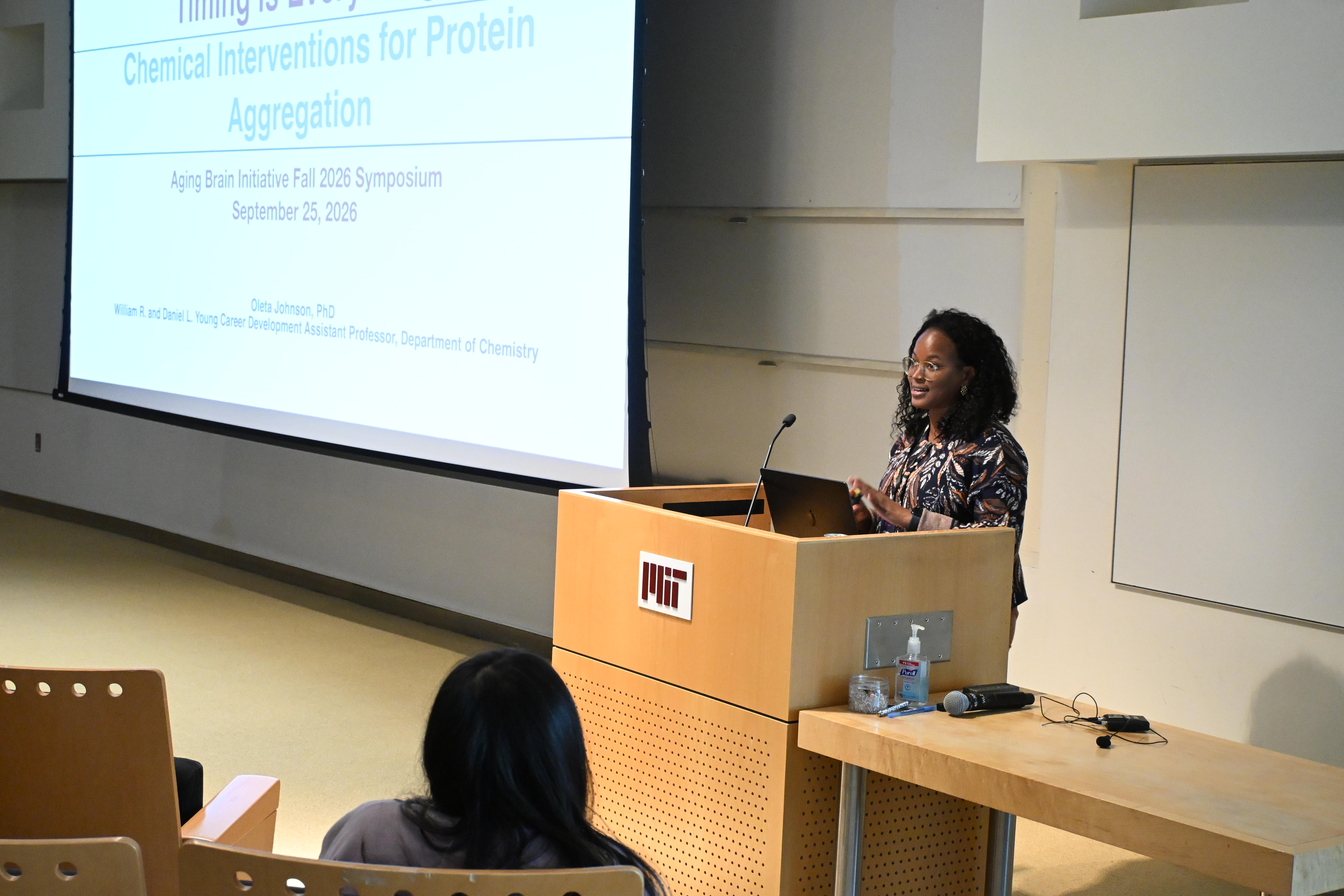
In many neurodegenerative diseases associated with aging, such as Alzheimer’s and Parkinson’s, a major pathology is misfolding and aggregation of intrinsically disordered proteins, such as amyloid-beta or alpha-synuclein. In her talk, William R (1964) and Daniel L. (1995) Young Career Development Assistant Professor of Chemistry Oleta Johnson described her lab’s work to prevent aggregation before it starts. In pursuit of that strategy, she said her lab’s research is focused on developing the chemical knowledge and means to identify proteins at issue, detect that they are moving into a problematic state, and then control their conformation.
Eugene McDermott Professor in the Brain Sciences & Human Behavior Alan Jasanoff, a member of the BCS and Biological Engineering Departments as well as the McGovern Institute for Brain Research, described a very different application of chemistry to aging brain research. He described how his lab develops novel chemical probes to make molecules in the brain visible in magnetic resonance imaging. These include the neuromodulatory enzyme cholinesterase, which is the target of many of the few drugs approved to treat Alzheimer’s, and also lipids, which several brain cell types mishandle in Alzheimer’s, Tsai and others have shown. His lab has also developed technology to genetically encode a novel probe in brain cells to improve MRI visualization of brain activity.
And while many researchers focus on the prominent problems that proteins or lipids present in neurodegenerative disease, chemistry Professor Laura Kiessling discussed a less appreciated but still important component of cellular function: sugars called glycans that line the surface of cells. In particular, researchers have linked a glycan called heparan sulfate to Alzheimer’s disease. Kiessling’s lab, working with ABI founding member Ed Boyden, Y. Eva Tan Professor of Neurotechnology, is working to characterize and understand glycans. Her lab, for instance, has shown that glycans of different sequences organize on cell membranes so that they can bind and recruit specific proteins to distinct regions on cells.
“We are really excited about the fact that we’ve observed this now for the first time and have a toolkit to study other diseases,” she said. Understanding glycan binding could even give scientists a means to target different cells and cellular processes.
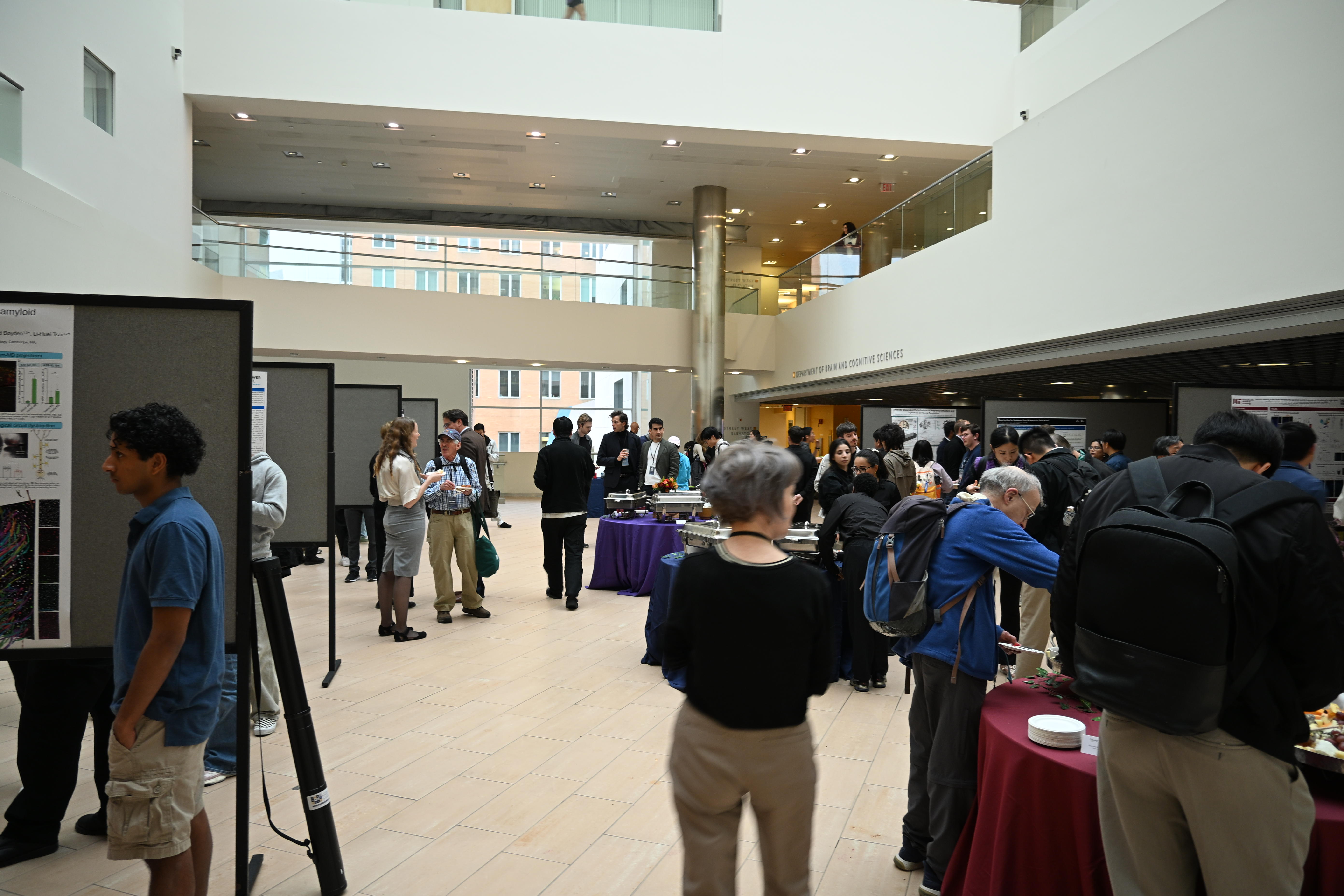
Following the six talks, more than a dozen trainees at a poster session presented even more aging brain-related projects from around the Institute, further highlighting MIT’s diversity of research in the area, something the ABI exists to encourage.
From massive AI datasets to the sugars on individual cells, the symposium highlighted how MIT scientists are pushing the frontiers of science and engineering to improve understanding of and interventions for the health of the aging brain.


