

August 19, 2026
A new theory, published in The Journal of Neuroscience by three scientists in The Picower Institute for Learning and Memory at MIT, offers an explanation of how the brain produces cognition and consciousness: It uses traveling waves of rhythmic neural activity to coordinate nimble neural networks with analog computations.
The metaphor that the brain operates with “circuits” is incomplete, said Picower Professor Earl K. Miller, the paper’s senior author. Indubitably, the brain’s physically connected circuits provide the infrastructure to store our memories and represent our ongoing needs and goals. But when we need to make improvised use of that knowledge in the rapid-fire, anything goes sensory context the world constantly throws our way, we can’t just depend on the relatively slow chemical process of rewiring those circuit connections called “synapses,” he said. Instead, the brain needs a control system that can coordinate millions of neurons to process information in a fraction of a second. Brain waves, long understood to be the synchronized rhythmic fluctuations of large groups of neurons, turn out to be performing that crucial service, Miller and his colleagues argue, citing years of experimental evidence from his lab and many others.
“Circuits and synapses are important and fundamental, that’s the start. But there is more going on,” said Miller, a member of MIT’s Brain and Cognitive Sciences faculty. “The brain generates waves, and wave dynamics are a highly efficient way to coordinate and perform computation”
While digital circuits make calculations one step at a time through sequential switches and gates, analog computation, which can be performed via the interference of waves, processes multiple calculations in parallel. That’s not only more efficient, but also locally focused traveling waves happen to be a ubiquitous feature of the brain, the scientists note.
“The brain exploits its own physics,” wrote Miller and co-authors Scott L. Brincat and Jefferson E. Roy, who are research scientists in Miller’s lab.
The new theory is important not only because it provides an explanation of cognition and consciousness, but also because it asserts the potential importance of considering waves in clinical treatment. Conveniently, waves can be manipulated non-invasively.
“Developing treatments based on brain wave dynamics is not just an opportunity but also an obligation,” said Miller, whose lab is part of a collaboration studying brain waves in autism.
Building the analog argument
To make the case that the brain uses waves to coordinate neurons to produce cognition and consciousness, the scientists begin with the now well-established observation that many neurons don’t just do one job. Instead, they respond to multiple cues and contexts, essentially participating in multiple functional networks at once, a property called “mixed selectivity.” Miller and colleagues have argued for years that this gives the brain immense computational horsepower, but it also initially raised the question of how the brain organizes these multiple overlapping networks with such speed and flexibility to produce the nimble thought we all depend on.
After numerous studies, the answer that has emerged for Miller and many other neuroscientists is that brain waves organize neural ensembles to process information. Miller has shown that brain waves of different frequencies govern cognitive processes such as working memory and predictive coding. Relatively slow “alpha” and “beta” frequency waves, representing memories and goals, regulate faster frequency “gamma” waves, which represent and report incoming sensory information.
The new theory posits that these alpha/beta control waves emerge from the coordinated spiking of neurons in circuits (connected at junctions called “synapses”) that encode stored memories and goals.
“Synapses store representations, while wave dynamics help determine which representations are active at any given time,” the authors wrote.
In some of the Miller lab’s newer research, the team has found evidence that even as waves emerge from neural spiking, the waves can rapidly grow to directly influence and coordinate spiking via an electric field-mediated process called ephaptic coupling. Importantly, electric fields can exert this coordinating influence very rapidly.
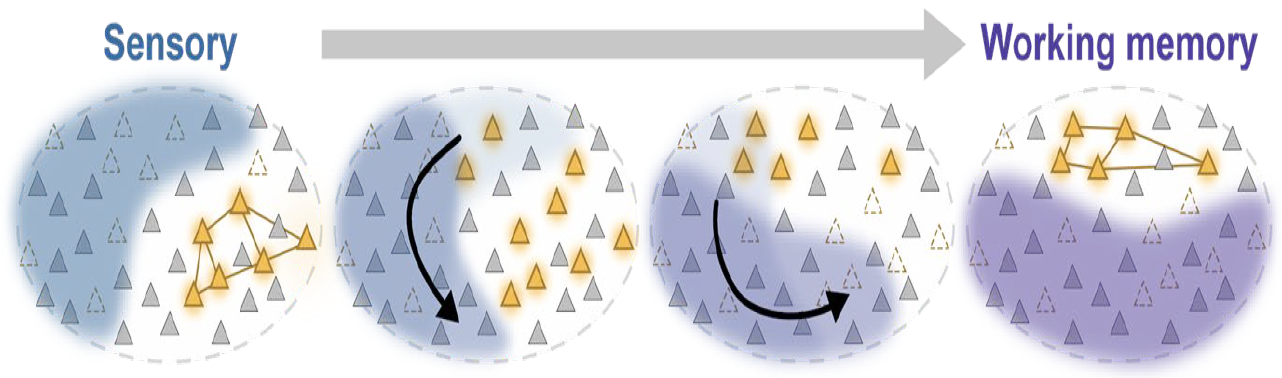
Another essential component of the theory, which Miller’s lab has also shown experimentally, is that alpha/beta waves are capable of exerting their control spatially, by affecting local areas of the cortex, and temporally, by traveling along the cortex. Essentially, the beta waves act as mobile stencils that govern where and when gamma waves can process sensory information and which ensembles of neurons will participate. Taken together, this suggests that the brain engages in “spatiotemporal computing,” the authors write. And where the waves intersect, they can add and subtract, enabling analog computations.
Miller acknowledges that his lab’s next step should be to provide direct evidence that the analog computations are taking place.
“This is a theory. We aim to test it by looking for signatures of analog computation in brain wave patterns,” Miller said.
Connection to consciousness
The article asserts that consciousness “emerges when these dynamic wave patterns bring the cortex in an organized, globally integrated state, one that naturally links and influences widespread activity.”
Some of the most compelling evidence linking wave dynamics to consciousness, comes from studies of general anesthesia that Miller has conducted with Picower Institute colleague Emery N. Brown, who is an Institute Professor at MIT, an anesthesiologist at Massachusetts General Hospital and a Professor in Harvard Medical School. Their labs have shown that three different drugs, each with different molecular mechanisms of action, all similarly disrupt brain wave dynamics to produce unconsciousness.
“Consciousness depends less on specific receptors or cell types and more on the integrity of large-scale wave organization,” the authors write in the review.
In other words, much like cognition, consciousness depends on how the brain efficiently organizes itself with brain waves.
“Electric field dynamics offer a low-overhead substrate for organizing and coordinating information across cortical networks,” they conclude. “Given strong evolutionary pressure to maximize computation per unit energy, it would be surprising if evolution did not exploit such a built-in analog computing substrate.”
The Freedom Together Foundation, The Picower Institute for Learning and Memory, the Army Research Office, Office of Naval Research, A MURI grant, The National Institutes of Health, and The Simons Center for the Social Brain supported the research.


