

October 26, 2026
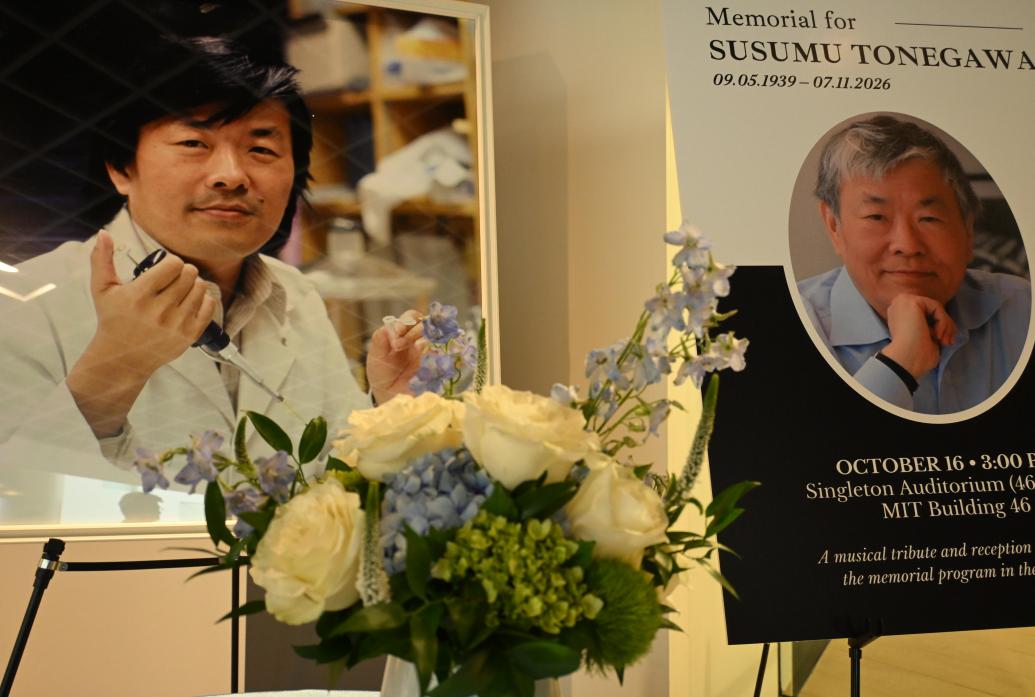
Before he passed away on July 11, Susumu Tonegawa had been a professor at MIT for more than 40 years. At a memorial service Oct. 16, colleagues, mentees and other friends spanning almost the whole arc of his illustrious MIT career gathered with members of his family to celebrate his life with recollections and stories that praised not only his science and achievements, but even more so his humanity.
Memorial fund
At the memorial, Picower Institute Director Myriam Heiman announced that a generous donor has pledged $100,000 to launch the Susumu Tonegawa Memorial Fund, an endowed fund that will provide enduring support for curiosity-driven research at The Picower Institute. Additional gifts will help grow the fund and expand its long-term impact, ensuring that Dr. Tonegawa's spirit of scientific discovery continues to inspire future generations of researchers.
To contribute, give online or email memorial-gifts-office@mit.edu.
The picture that 16 speakers collectively painted was one of a man who simultaneously demanded excellence and yet consistently demonstrated kindness and a joyous enthusiasm for science (and art and baseball). Though he was a 1987 Nobel Laureate for his breakthrough immunology research and is renowned for his groundbreaking research on memory, the testimonials dwelled little on his awards. Instead, they focused on a much more personal and intimate degree of inspiration and impact.
Scientist & mentor
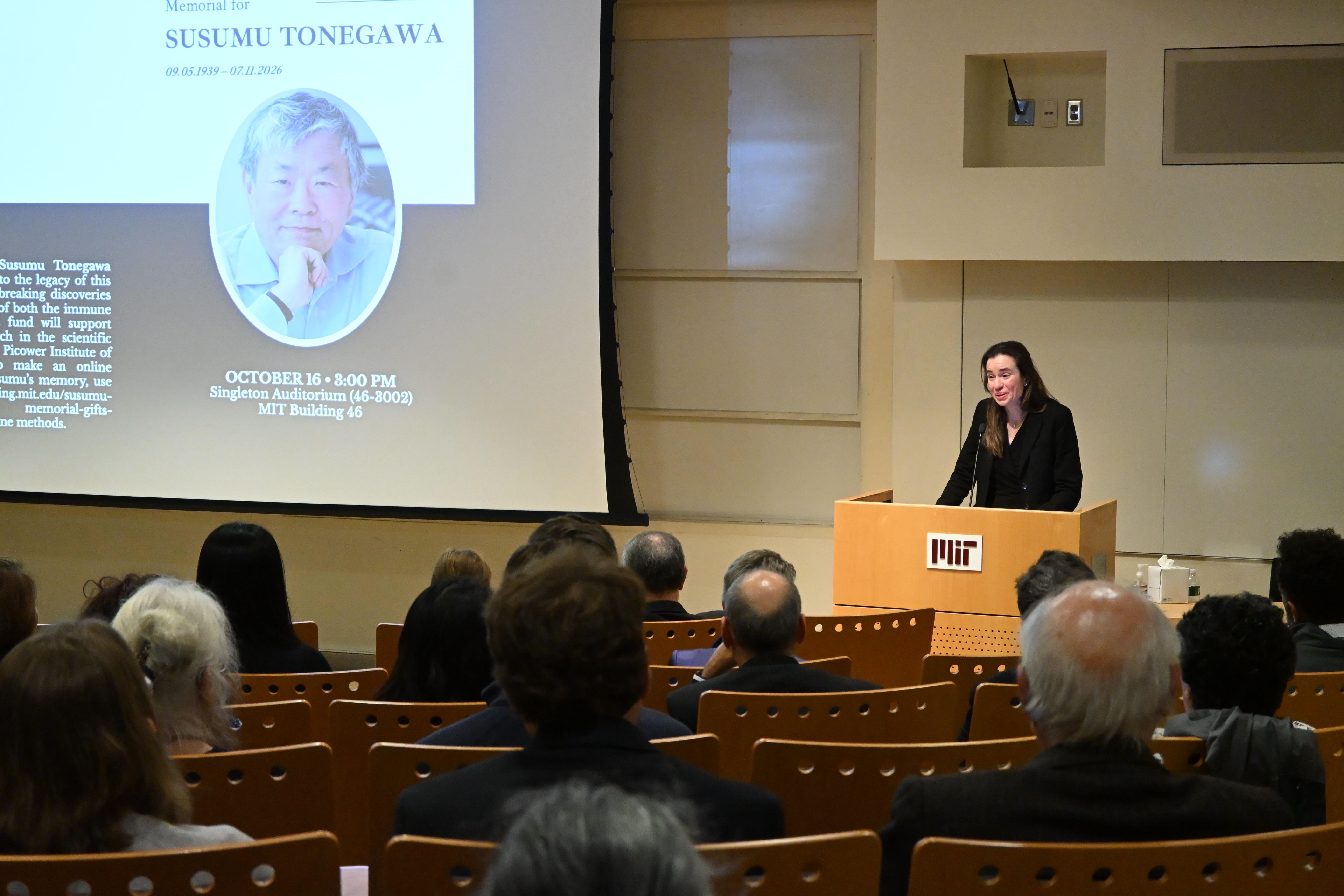
Picower Professor Myriam Heiman, director of The Picower Institute for Learning and Memory that Tonegawa founded as MIT’s Center for Learning and Memory in 1994, had been a colleague of Tonegawa’s for 15 years. But she shared that his work in the fields of immunology and memory had been an inspiration to her long before that—ever since she was an undergraduate student at Princeton. There, she studied his work to explain the diversity of antibodies during an immunology class at the same time she was reading a Proust novel dedicated to how memory and art can restore and make immutable what would otherwise be lost to time.
Professor Amy Keating, head of Tonegawa’s home the MIT Department of Biology, hailed his passion for molecular biology as an inspiring example for students. She noted that he took big risks to learn the emerging subject in the 1960s by moving across the Pacific Ocean to enroll in graduate school in San Diego. And while he achieved historic results by applying molecular biology to both immunology and neuroscience, he only did so after persisting through worries that he and his fellow PhD students shared about the future of the field when they graduated in 1968.
Much like Tonegawa learned molecular biology from the ground up, former graduate student Arvind Govindarajan, now at McKinsey & Company, joined Tonegawa’s lab in 1999 based on his curiosity about the brain rather than based on having had any prior neuroscience training. He affirmed that Tonegawa encouraged his mentees to be ambitious and to dream big, even if they didn’t start out familiar with the subject matter. Govindarajan quoted Tonegawa as saying, “It is irrelevant what you know. It only relevant what you want to work on.” And similarly encouraged him to “have no fear, if the problem is interesting, go forth and do it, but when you publish, it has to be perfect.”
Another early mentee from the 1990s, Tom McHugh of the RIKEN Center for Brain Science in Japan, similarly described Susumu’s assertive encouragement, quoting Susumu as saying, “A journal doesn’t make your paper good, your paper makes the journal good.” But McHugh also noted that Tonegawa advised against ever resting on one’s laurels by often quoting the Japanese proverb: “After victory, tighten your helmet.”
Though Tonegawa pushed for excellence, even down to the details, 1980s mentee Juan Lafaille of New York University reminded the gathering, “He was, at least, as demanding of himself as he was of us.”
And Tomás Ryan, a postdoc in Tonegawa’s lab from 2010-2016, emphatically seconded the idea that Tonegawa’s advice was not only worth receiving, but also passing on. He shared a list of seven lessons that guide how he runs his own lab at Trinity College in Dublin, from where he flew in to join the ceremony.
“In Ireland we often say, you should never meet your heroes, you’ll only be disappointed,” Ryan said. “For me, the exception to this maxim was Susumu…I was incredibly fortunate to have Susumu as a mentor.”
Builder of communities
Many other speakers remembered Susumu as a community builder, not least because he founded The Picower Institute.
MIT School of Science Dean Nergis Mavalvala praised Tonegawa for building a community of neuroscience at MIT that has had impact well beyond his pioneering work on how memories are stored, recalled and associated with feelings and relationships. The Picower Institute today comprises 16 labs and about 400 people and hundreds more have trained in its labs over the decades.
“It takes a vision bigger than your own science and your own lab to be part of founding something this influential and I really admire him for that,” Mavalvala said.
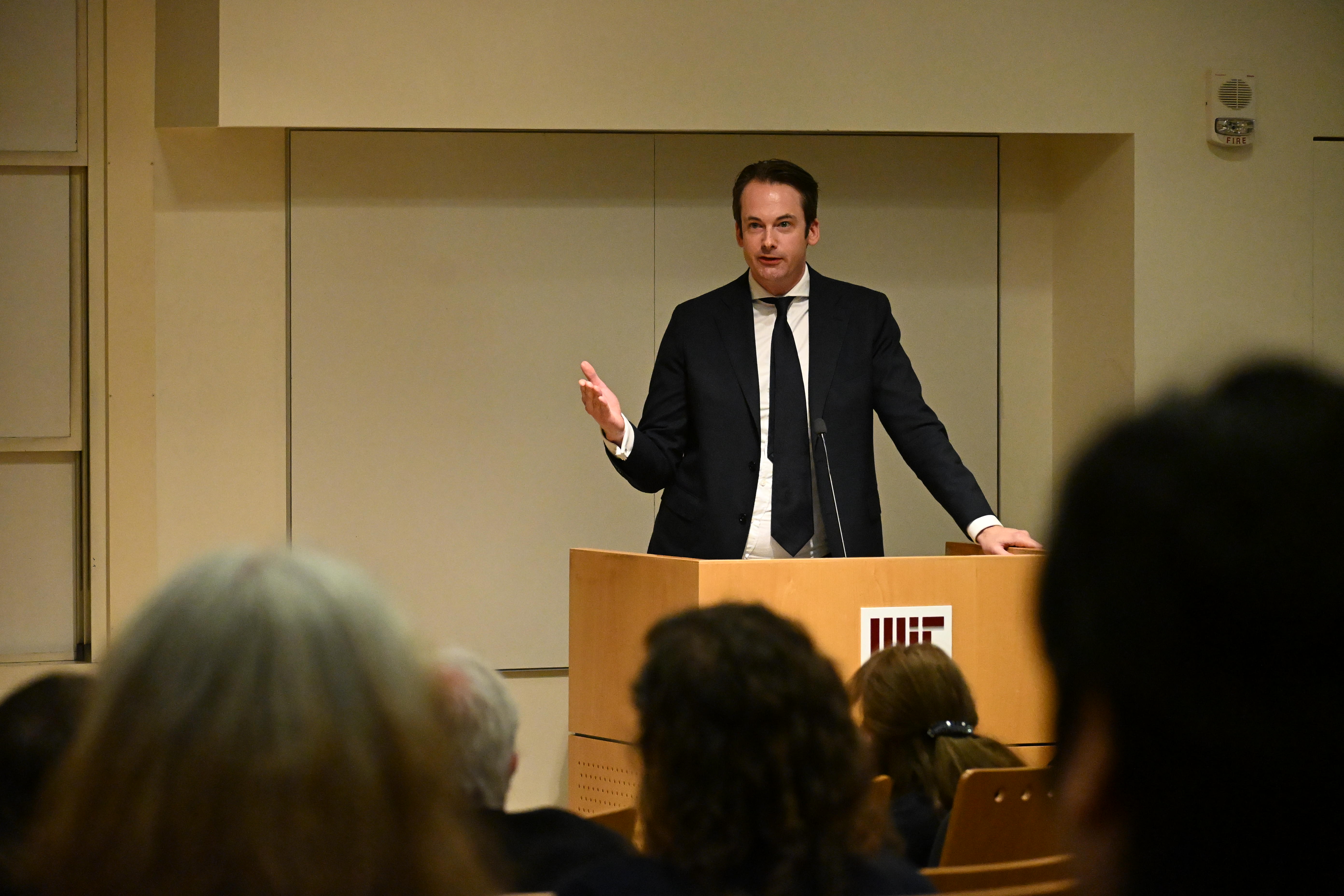
Matt Wilson, the first professor Tonegawa hired into the “Center for Learning and Memory,” (now the Picower Institute) recalled Tonegawa’s absolute confidence. Wilson for instance, didn’t bother renovating any lab space, because he believed (correctly, it turned out) that Tonegawa would deliver on the promise of an entirely new building (Building 46).
“The thing that really struck me was not just his infectious enthusiasm, but the absolute certainty that he had that this was going to be a success, that this was going to have impact,” Wilson said. “We built everything from scratch.”
Govindarajan recalled how Tonegawa involved himself deeply in the design of Building 46, working with architect Charles Correa to make sure every lab space would be the best it could be. And MIT Corporation member and longtime Tonegawa friend Barrie Zesiger fondly recalled a story about how when the building was new, Tonegawa stood with her at a huge window overlooking the train tracks that run directly underneath. They stayed perfectly still with their hands on the window as the train ran under, but after it passed he was elated that the vibrations were so minimal.
“It was like a child, the joy on his face,” she recalled.
Biology Professor Chris Kaiser recalled how as an assistant professor he worked with Tonegawa when he was recruiting young faculty to the new learning and memory center, including Wilson, Troy Littleton, and Elly Nedivi.
Zesiger said, “He loved his learning and memory colleagues – loved them all, all of you.”
Honest, joyous and kind
Picower Professor Li-Huei Tsai, among the later of Tonegawa’s Picower faculty recruits, said she frequently sought his advice during her 17 years as Picower Institute director. He was “unfailingly honest” yet warm and supportive, she said. And he never lost his sense of wonder.
“I came to value that honesty enormously,” Tsai said. “It is only now beginning to sink in that I will no longer be able to turn to him for his sage advice.’’
Longtime and current lab member Michele Pignatelli, also admired the child-like passion and wonder that Tsai and so many others recalled. He recounted how, when he first learned from Tonegawa’s wife Mayumi that Tonegawa had passed away, he initially felt heartbreak and anxiety, but that quickly transitioned to “an overwhelming sense of gratitude.”
“Working with Susumu has been the greatest honor of my life,” Pignatelli said. “We will keep the flame burning.”
In his own personal tribute to Tonegawa, Peter Mombaerts, a graduate student from Tonegawa’s immunology days who is now the director of Max Planck Research Unit for Neurogenetics in Frankfurt, was one of the few to dwell even for just a moment on Tonegawa’s Nobel Prize. But he did so only to make the point that Tonegawa did not suffer from “Nobelitis,” a loss of humility and perspective said to sometimes afflict those who’ve achieved their field’s highest honor.
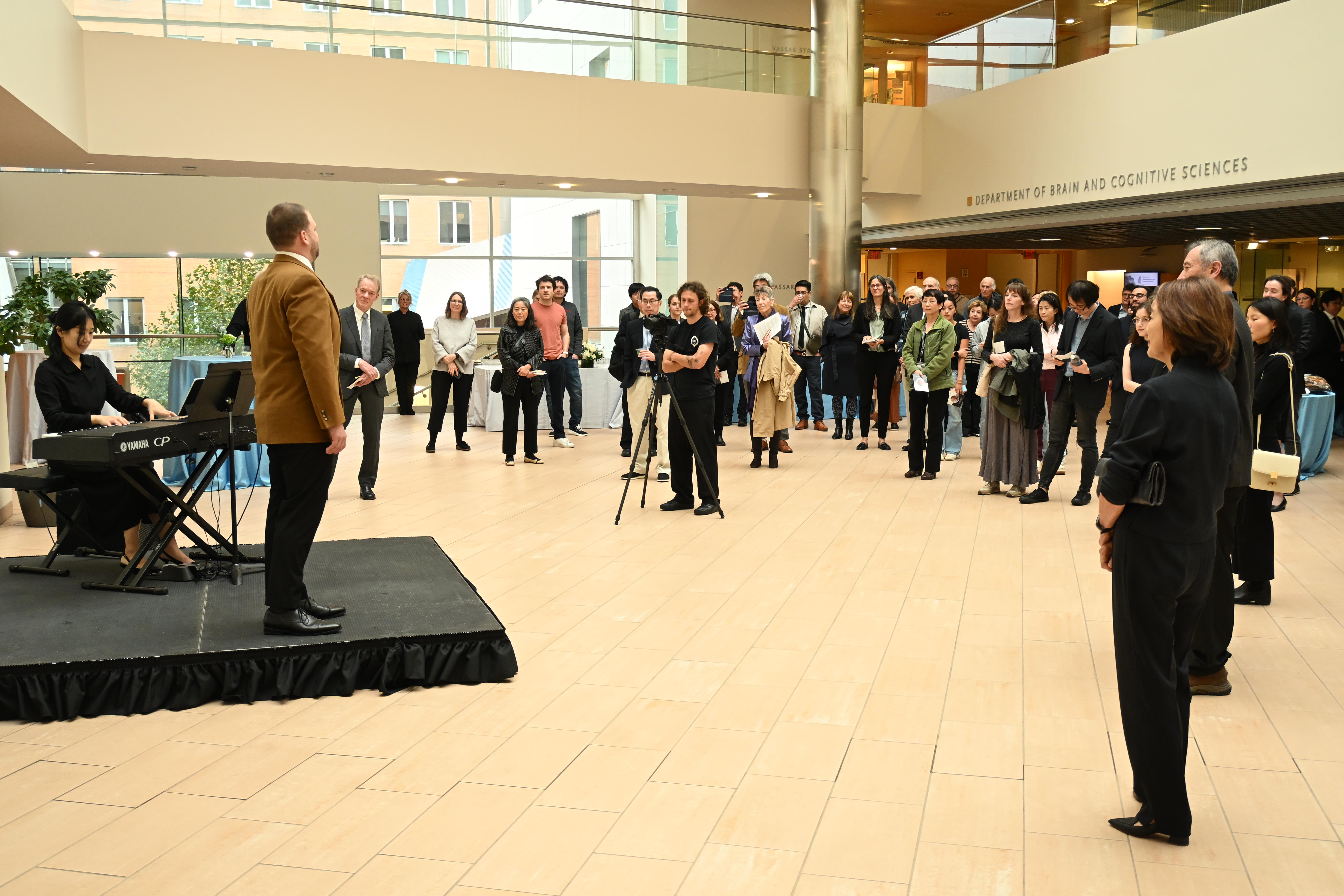
In an especially poignant anecdote illustrating Tonegawa’s capacity for humility and kindness, current lab postdoc Quentin Ferry shared that he has a young daughter with a set of disabilities that often leave people unsure of how to interact with or understand her. She is often therefore left out. But at a lab cookout last summer, Ferry heard his daughter laughing. Tonegawa was playing with her joyfully.
“He didn’t see a condition to be nervous around, he saw a little girl who wanted to play,” Ferry said. “We will all remember Susumu’s brilliance. What I wish is that we also carry forward his kindness.”


