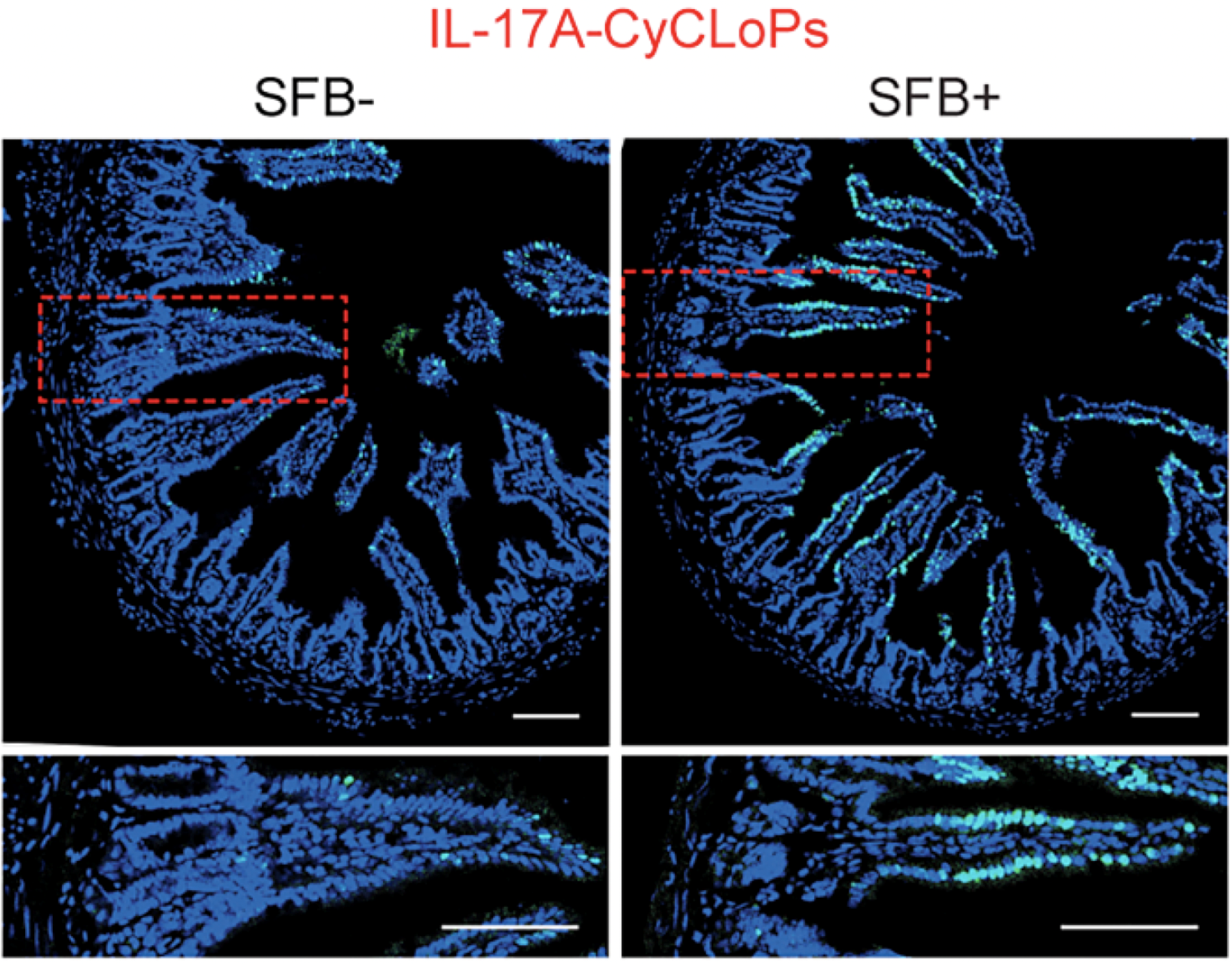


The body’s immune system exerts widespread effects, including in the brain, where research in the lab of Associate Professor Gloria Choi has shown that immune cell signaling molecules known as “cytokines” can influence behavior in many ways when they find receptors on neurons. Across the whole body, however, scientists know a lot more about the immune cells sending out cytokines than they do about the other cells they contact or the effect that has.
To spatially and temporally track cellular responses to cytokines, Choi and colleagues including Harvard immunologist Jun Huh invented “CyCLoPs,” or “cytokine cellular locating platforms.” CyCLoPs cleverly adds a few proteins into the cytokine binding process, such that when a cytokine binds to its target receptor in a cell, the ensuing chain of molecular events produces an imageable glow. Specifically, receptors have two subunits (say, A and B). When the cytokine binds to A, it comes together with B. In CyCLoPs, an enzyme inserted at B cuts loose a protein attached to A. When that protein reaches the cell nucleus, it triggers the fluorescence that has been genetically programmed to result.
In a 2026 paper in Cell, Choi and Huh’s team introduced CyCLoPs by describing it and demonstrating two instances of its use: They highlighted cells responsive to Interferon gamma and to Interleukin 17A, in the context of tumors and after bacterial (SFB) exposure. The system can be applied for many other kinds of cytokines, too.
“Collectively, CyCLoPs offers a platform for the direct visualization and characterization of cytokine-induced cellular responses and provides a tool for investigating how cytokines orchestrate distinct immunological outcomes in health and disease,” they wrote. And already a second‑generation CyCLoPs capable of measuring cytokine responses in the brain is underway.