


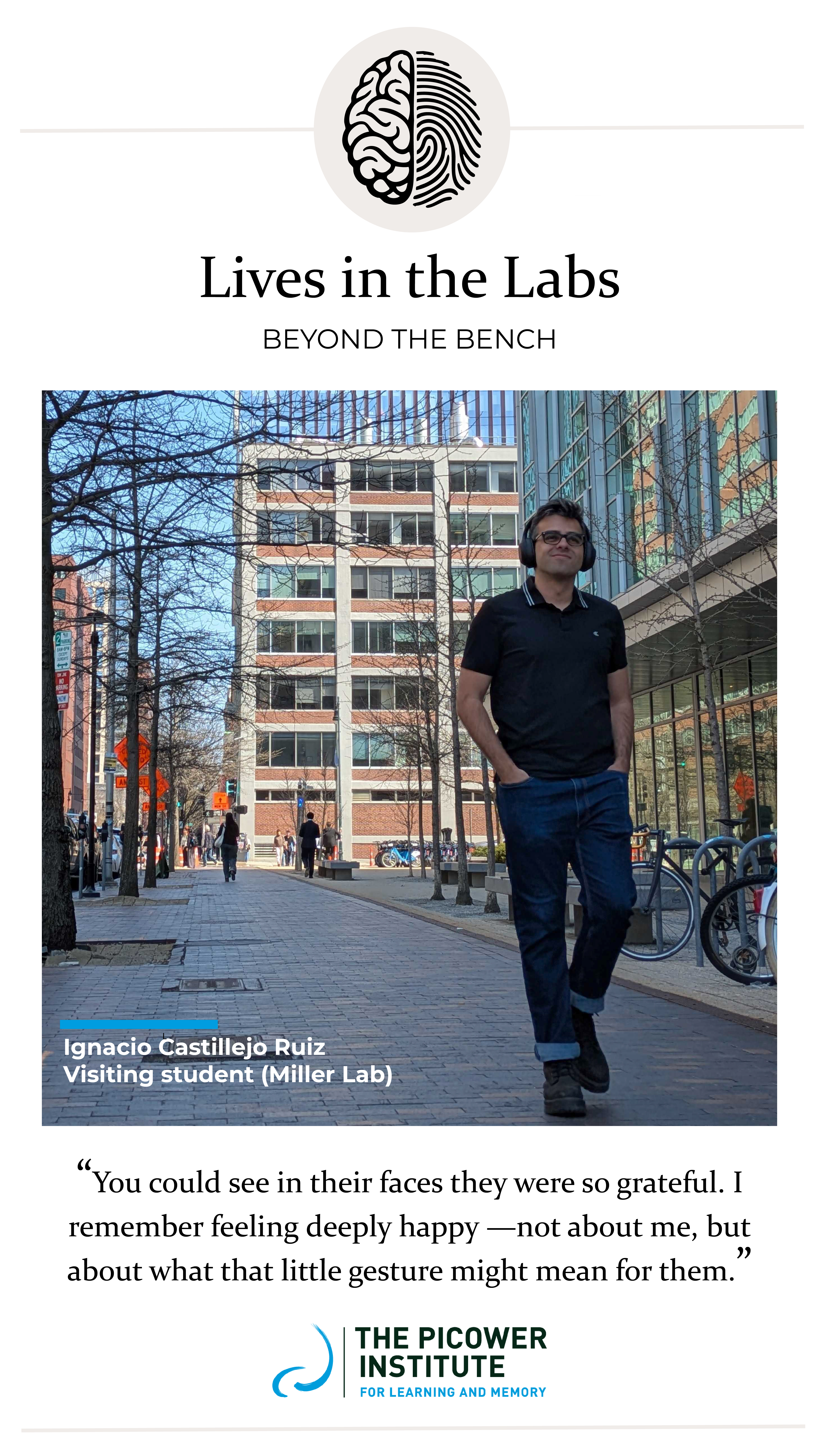
"I listen to podcasts by Jay Shetty. He is a former monk and gives you some thinking to do about how to be a human in the world. Part of it has to do with serving; it gives you a holistic view of who you are. Sometimes we see ourselves as the protagonist of our story, but I like that feeling of changing the scope when helping others. It's not always easy to have that kind of perspective when you're doing basic science, because it's detached: you're not directly helping someone overcome a disease or something like that, but you are building the groundwork to make that happen. So, I've been trying to figure myself out in this context: You want to help others, but you are clearly driven by discovering things in basic science. I see that my work might be a way to serve society. It's like being an explorer. Explorers have the incredible opportunity to be the first to enjoy something and find something beautiful, but you are not doing that for yourself, right? The whole point is to show it to others. When you ask, “what brings you joy?” I had the answer clear in my head: “helping others.” Like when you do a small favor for someone... I remember I went on the InterRail in Europe. I came back to Spain and I felt deeply connected to this joy of helping others. I was taking one of my walks in the center of Madrid while listening to a Jay Shetty podcast, and I remember a couple asked me for some money to buy food. They even told me I could come with them and actually buy the food. So, I was in this deep state of “I love the world and I love others” so I said, “sure let's go.” We went to a McDonald's—nothing very special— and I told them: “You can order whatever you want.” And they were like, “What are you saying?” You could see in their faces they were so grateful. I remember feeling deeply happy —not about me, but about what that little gesture might mean for them. I would like them to keep their hope that the world can actually respond and help them. Treating them as humans. Sometimes, in big cities, people get dehumanized, and I think that the greatest thing we have is connecting to each other. Breaking the cultural or societal roles —even if for a moment."