


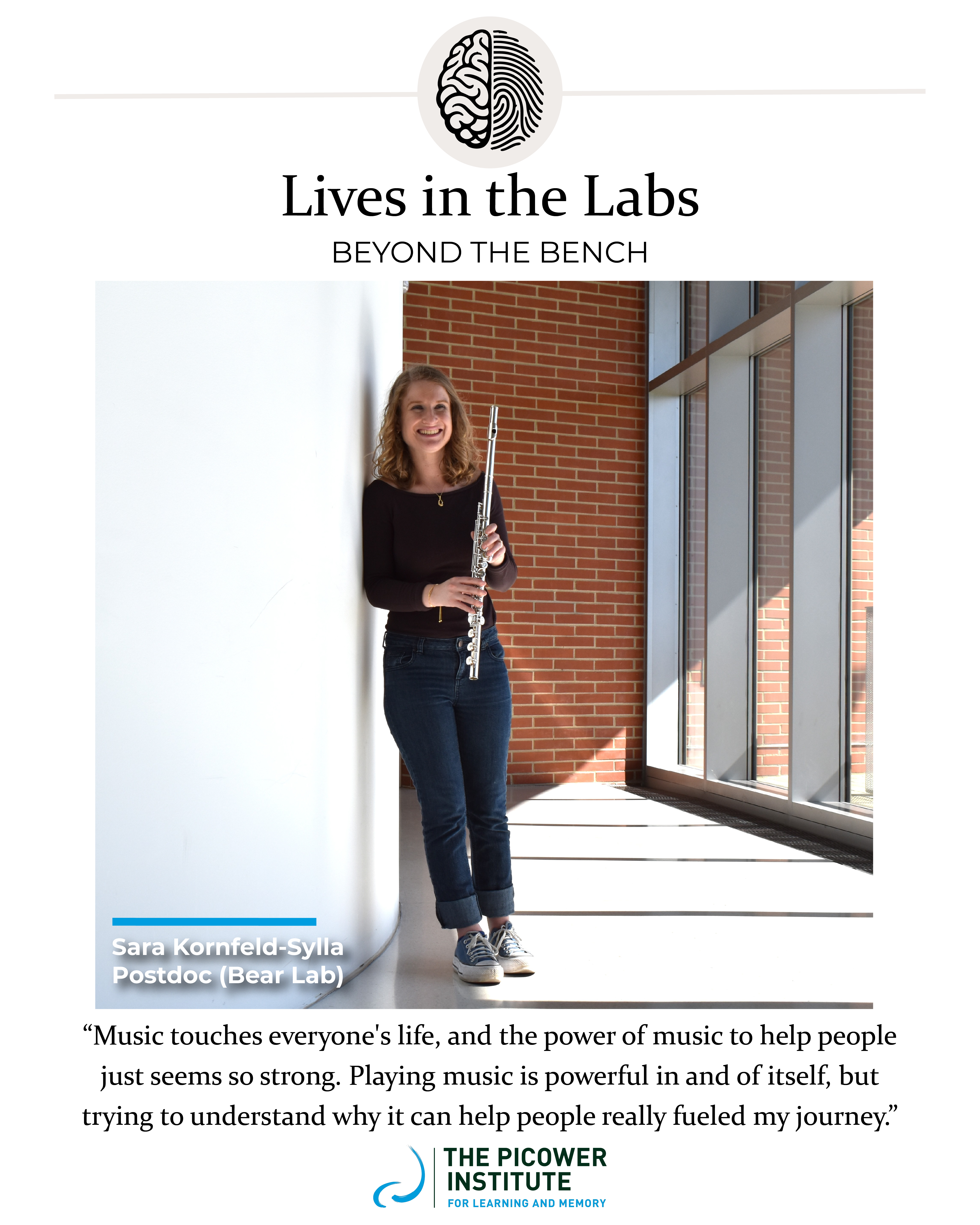
"I had a conductor in middle school county honor band who had Parkinson's disease. He had the typical symptoms of rigidity and bradykinesia, but incredibly, he could conduct. Something about the organized pattern of music allowed him to conduct even though he struggled to move otherwise. This made me realize there's something special about music in the brain. I was inspired by that. In high school, I worked on a science fair project, applying calculus I’d learned to model neural activity. The goal was to explain perception of a cool optical illusion, but I also wanted to tie the work to Parkinson's . I included a parameter to model the loss of dopamine in Parkinson’s, and as I fiddled around with different parameters, I was able to simulate a range of neural activity—from what might happen viewing the optical illusion to aberrant synchronous activity that happens in Parkinson’s. When I presented my project to my class, I had the students raise their hands if they had a family member or knew somebody who had Parkinson’s. I was shocked by how many people raised their hands. I earned a fellowship related to this project. In my acceptance speech, I spoke about how my inspiration traced back to my middle-school music experience. Afterward, somebody came up to me and said they had Parkinson's disease, with all the difficulty moving, but they found that if they put their hands together in a certain way, stabilizing their fingertips, they could somehow lower their hands to the piano and play fluidly. It was a full-circle moment. Not only did it reinforce that this research area affected so many people’s lives, but it meant that there was something magical about music for his brain, too. Music touches everyone's life, and the power of music to help people just seems so strong. To me, playing music is powerful in and of itself, but trying to understand why it can help people really fueled my journey to understand how brain activity is changed by neurodegeneration, or, more recently, neurodevelopmental disorders. Really, I ended up doing neuroscience because of music. It’s been a winding path, but I think ultimately it came down to realizing how many lives this touches."